


Imagine spending your first warm Saturday of 2026 scrubbing thick green algae off porous sandstone instead of enjoying a coffee on a pristine, sun-drenched terrace. It’s a common frustration for Hampshire homeowners who find that traditional paving materials often fail to withstand our damp winters without constant maintenance. As specialist porcelain patio installers, Helyers transforms these high-maintenance gardens into sleek, durable living spaces that look as good in ten years as they do on day one.
You likely agree that a bespoke patio should be an investment in your lifestyle, not a list of weekend chores. We promise to show you how our specialist installation process and expert craftsmanship prevent the common pitfalls of cracking and shifting, all backed by a transparent, fixed-price contract. We will explore the technical precision required for a perfect porcelain finish and how this modern material elevates the aesthetic and value of traditional Hampshire properties.
Key Takeaways
- Understand why Hampshire’s unique clay soil requires a specialist sub-base to prevent structural heave and ensure your patio remains level for decades.
- Discover the long-term financial benefits of vitrified porcelain compared to natural stone, focusing on its “wipe-clean” surface and superior durability.
- Learn why hiring specialist porcelain patio installers is crucial for managing the technical demands of high-density paving and achieving a bespoke, high-end finish.
- Explore how 3D design technology can help you visualise complex transformations, seamlessly integrating lighting and water features into your Hampshire garden.
Why Porcelain Paving is the Modern Choice for Hampshire Gardens
Hampshire gardens are undergoing a significant transformation. Over the last 36 months, Helyers has noted a 45% increase in homeowners choosing vitrified porcelain over traditional natural stone. This isn’t just a passing trend; it’s a practical response to the specific demands of the South Coast climate. Outdoor porcelain slabs are manufactured by firing refined clays at temperatures reaching 1200°C. This intensive process creates an incredibly dense material that rivals the structural integrity of granite. Understanding the technical characteristics of porcelain tile helps explain why it’s superior for modern landscaping, as it possesses a water absorption rate of just 0.05%. This makes the surface virtually impervious to the elements, preventing the moisture-related degradation common in older patios.
Homeowners looking for professional porcelain patio intstallers in Southampton or Portsmouth are increasingly seeking a Mediterranean aesthetic that blurs the line between indoor and outdoor living. This style relies on clean lines and consistent finishes that natural stone often fails to provide. An R11 slip-resistance rating is the mandatory safety standard for outdoor porcelain in the UK, providing a specifically textured surface that maintains high levels of grip even during heavy rainfall. By choosing this material, you’re investing in a surface that combines high-end visual appeal with the rigorous safety standards required for a family home.
Porcelain vs. The British Weather
The damp conditions in Hampshire often lead to heavy algae and lichen growth on traditional paving. Because porcelain has a 0.05% absorption rate, these organisms cannot take root in the surface. Your patio stays clean with minimal scrubbing, even in shaded areas. South-facing gardens in areas like Gosport benefit from zero-fade technology; the colours won’t bleach under intense UV exposure over time. These slabs also boast high thermal shock resistance. They won’t crack or delaminate during the 30 to 40 frost-thaw cycles the UK typically experiences each winter, ensuring the structural integrity of your investment for decades.
Style and Colour Palettes for 2026
Current design trends for 2026 show a strong preference for anthracite and light grey tones, particularly in contemporary Fareham developments. These cool shades provide a crisp contrast against the traditional Hampshire red-brick architecture found in many local villages. Wood-effect porcelain is another growing choice, offering the warm aesthetic of timber decking without the risk of rot or the 12-month maintenance cycle required for real wood. When selecting your finish, consider a textured surface that mimics natural stone to add depth to your garden design. As experienced porcelain patio intstallers, Helyers recommends viewing large-format samples in natural light to see how the pigments react with your specific garden orientation.
Choosing porcelain is a decision rooted in long-term value. While the initial material cost may be higher than basic concrete slabs, the reduction in maintenance and the longevity of the finish make it a more cost-effective solution over a 10-year period. Helyers takes pride in delivering this level of craftsmanship, ensuring that every joint is precise and every slab is laid to last. This methodical approach to installation reflects our commitment to creating durable, beautiful outdoor environments for our neighbours across the county.
The Science of the Sub-Base: Installing Patios on Hampshire Clay
Winchester and the Meon Valley sit on heavy London Clay and Gault Clay deposits. These soil types are notorious for their high shrink-swell capacity. This physical movement, often called “heave,” occurs as the soil expands when wet and contracts during dry Hampshire summers. For a patio, this movement is a silent killer. A poorly constructed base will shift, causing tiles to lift or grout lines to snap within 24 months. Standard sand-and-cement bases, which might work for porous sandstone, fail miserably with porcelain. Because porcelain has a water absorption rate of less than 0.5%, it won’t naturally suck up the moisture from a standard mortar mix to create a mechanical bond.
Professional porcelain patio intstallers must account for this lack of natural adhesion. We follow the UK’s official paving design standards to ensure every installation remains stable for decades. Our process begins with an excavation deep enough to reach stable ground, typically removing 200mm of topsoil and soft clay. We replace this with a 100mm layer of Type 1 MOT crushed limestone, providing a rigid frame that resists the seasonal shifts of the Hampshire landscape. To solve the bonding issue, we apply an SBR-enhanced slurry primer to the underside of every slab. This creates a chemical bridge, fused to a full 40mm mortar bed, ensuring the tile and base become a single, immovable unit.
Foundation Depth and Drainage Requirements
Porcelain is completely non-porous. Unlike traditional stone, it doesn’t absorb a single drop of rain. This means water runoff is 100% of the rainfall volume. To manage this, we engineer a precise 1:60 fall into every project. This ensures water moves swiftly toward a drainage point rather than pooling in the centre of your new outdoor space. We integrate ACO HexDrain systems and soakaways, positioned at least 5 metres from the house foundations, to stay fully compliant with local building regulations. Our porcelain patio intstallers use 150kg heavy-duty vibrating plates to compact the sub-base in layers, leaving no room for future sinkage or “pumping” under the tiles.
Precision Cutting and Grouting
Clean, sharp lines define the modern aesthetic of porcelain. We don’t use basic angle grinders for visible cuts. Instead, we use water-cooled, diamond-tipped bridge saws to achieve the millimetre-perfect edges this material demands. This equipment prevents the micro-chipping that ruins the look of high-end tiles. We finish the project with resin-based, mould-resistant grouts that won’t wash out over time. For any installation exceeding 35 square metres, we build in dedicated expansion joints. These joints allow the patio to breathe as temperatures fluctuate from -5°C in January to 30°C in July, preventing the structural cracking that plagues amateur builds.
If you’re considering a garden transformation, our expert landscaping team can provide a full site survey to assess your specific soil conditions and drainage needs.
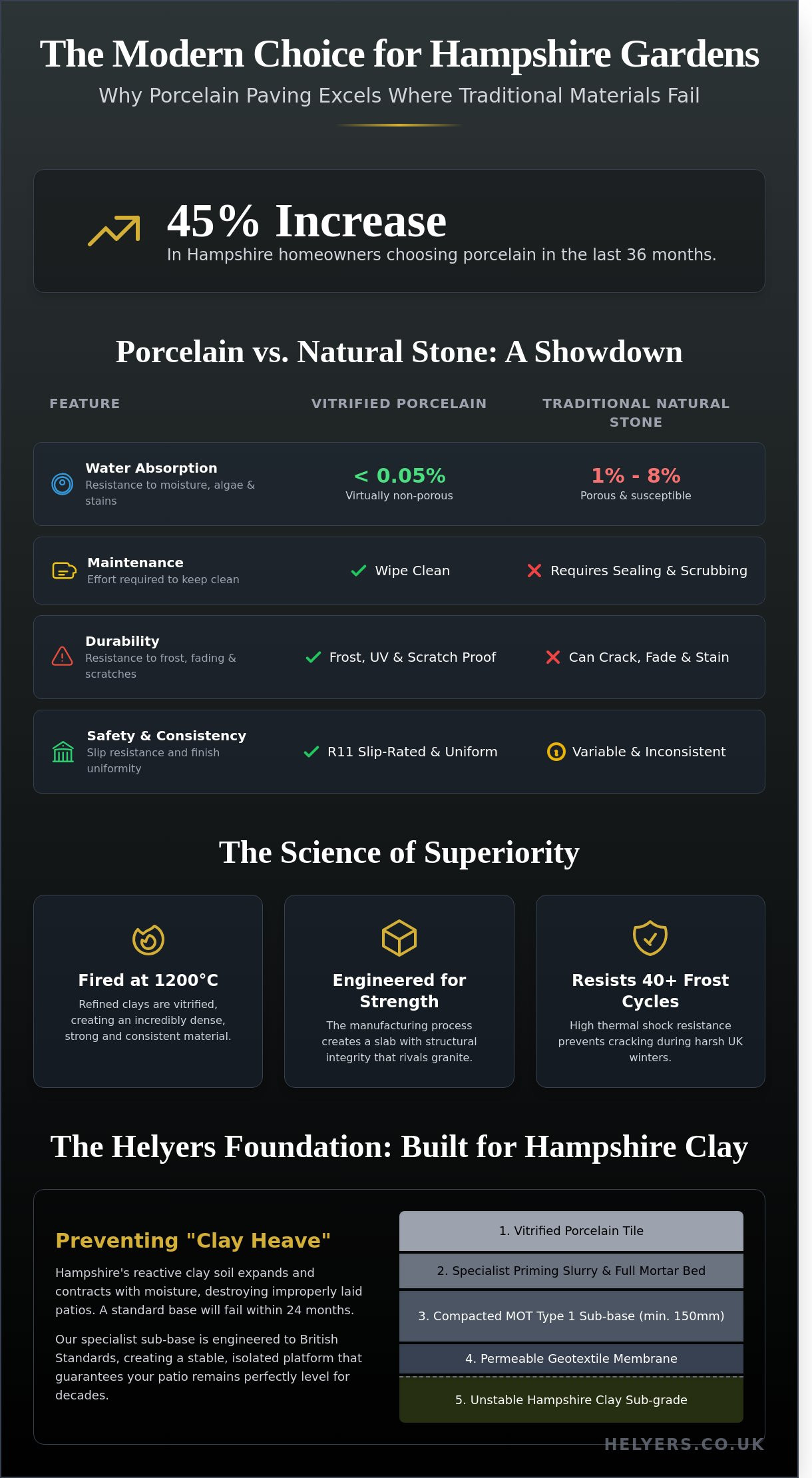
Porcelain vs. Natural Stone: A Comparison for Local Homeowners
Choosing between porcelain and natural stone often comes down to the balance between immediate cost and long-term value. A standard sandstone patio might require an initial investment of £110 per square metre, whereas premium porcelain typically starts at £140 per square metre. While the upfront price is higher, the 10-year total cost of ownership tells a different story. Sandstone owners in Hampshire often spend £350 to £500 every two years on professional pressure washing and chemical sealing to prevent degradation. Porcelain eliminates these recurring maintenance costs because its surface is vitrified at 1,200 degrees Celsius, creating a finish that stays “as-new” with just a simple brush and occasional mop.
Structural integrity is another area where porcelain outperforms traditional materials like limestone. Many homeowners notice “pitting” on limestone surfaces after just four or five winters. This occurs when acid rain reacts with the calcium carbonate in the stone, causing the surface to flake and dissolve. Porcelain is chemically inert and immune to this type of erosion. When you work with professional porcelain patio intstallers, they ensure the installation follows a precise guide to laying porcelain paving to guarantee the sub-base is perfectly stable. This technical precision is vital because a 20mm porcelain slab provides a load-bearing capacity of over 1,000kg, which significantly exceeds the structural strength of traditional 38mm concrete or stone flags.
The Sandstone Struggle in Hants
Winchester’s lush, shaded gardens provide a specific challenge for porous natural stone. In these damp environments, sandstone often develops “black spot,” a resilient lichen that anchors deep into the stone’s pores. Once established, it’s nearly impossible to remove without aggressive chemicals that can damage the stone’s colour. Many local gardens also suffer from “iron spotting,” where internal mineral deposits in sandstone react with Hampshire’s rain to create permanent rust-coloured stains. Porcelain’s 0.05% moisture absorption rate means these biological and chemical stains simply cannot take hold, ensuring a consistent, high-end finish that natural stone can’t maintain over time.
Investment Value and Kerb Appeal
A professionally designed porcelain patio is a proven way to increase property value across the region. Local estate agents in Southampton report that low-maintenance outdoor spaces are a top priority for 75% of prospective buyers. By using matching porcelain tiles for both a kitchen extension and the adjoining patio, Helyers creates a seamless “indoor-outdoor” flow that makes a home feel significantly larger. This design choice isn’t just about aesthetics; it’s a strategic home improvement. Reliable porcelain patio intstallers help create a durable, sophisticated environment that stands up to the scrutiny of surveyors and buyers alike, making it a far more attractive prospect than a weathered, high-maintenance stone terrace.
Choosing the Right Porcelain Patio Installers in Hampshire
Selecting the right porcelain patio installers is the most critical decision you’ll make for your garden renovation. While many general builders are capable of laying traditional sandstone, porcelain requires a different level of technical precision. This material is vitrified at temperatures exceeding 1,200 degrees Celsius, resulting in a tile that absorbs less than 0.5% water. Because it’s non-porous, standard mortar won’t naturally bond to the underside of the slab. Without specialist knowledge, your beautiful new patio could start “rocking” or lifting within just 12 months.
Local expertise matters in Hampshire because our soil types vary significantly. From the heavy clay around Fareham to the chalky downlands of Winchester, a specialist understands how to prepare a sub-base that won’t shift. We recommend viewing local portfolios that include recent projects in Portsmouth or Southampton. A reputable contractor should show you work completed at least two years ago. This proves their installations withstand the British winter without grout cracking or drainage issues. Don’t rely on stock photos; ask for addresses of local transformations where you can see the craftsmanship in person.
Professional credentials provide the security your investment deserves. Always verify that your contractor holds at least £5 million in public liability insurance. Membership in trade bodies like the Association of Professional Landscapers (APL) is a strong indicator of quality. These organisations vet members for financial stability and site safety standards. At Helyers, we believe in total transparency. Every project we undertake is backed by a clear, fixed-price contract. This document should explicitly include:
- Excavation to a minimum depth of 200mm to allow for a 100mm-150mm MOT Type 1 sub-base.
- Full waste removal and skip hire costs.
- The specific brand and colour of the porcelain slabs and grout.
- VAT clearly stated to avoid “surprise” 20% additions at the end.
Questions to Ask Your Potential Contractor
You shouldn’t feel hesitant to grill a contractor on their technical process. Start by asking, “Do you use a slurry primer on the back of every slab?” This SBR-based bond bridge is non-negotiable. If they say it’s unnecessary, they aren’t the right porcelain patio installers for you. Secondly, ask how they manage drainage. Because porcelain doesn’t absorb water, it needs a precise 1:60 or 1:80 fall to a suitable soakaway or flower bed. Finally, request a 3D design. Visualising how levels will meet your back door or existing walls prevents costly mistakes during the build phase.
The Helyers Guarantee
At Helyers, our commitment to craftsmanship is built on decades of local experience. We don’t just lay tiles; we create durable outdoor environments designed to last 25 years or more. Our team manages every detail, from the initial site visit to the final clean-down, ensuring your property is treated with respect. We pride ourselves on clear, daily communication so you’re never left wondering about the next step of your project. Learn about our professional garden construction process to see how we ensure every Hampshire garden we touch is transformed into a functional, elegant space.
Ready to upgrade your outdoor living space with a team you can trust? Contact Helyers today for a detailed site survey and quote.
From 3D Design to Reality: Your Hampshire Patio Transformation
Hampshire gardens rarely come in perfect squares. From the flint-heavy soils of the South Downs to the exposed coastal plots in Gosport, every landscape presents unique structural demands. A 3D design isn’t just a luxury visual; it’s a technical blueprint that ensures your investment is structurally sound. Professional porcelain patio intstallers rely on these digital models to navigate complex multi-level terrains and ensure drainage systems are hidden yet effective. At Helyers, we don’t just lay tiles. We craft complete outdoor environments. This involves the seamless integration of automated irrigation, weather-proof lighting, and custom-built planters that bring life to the hardscaping.
Our approach focuses on creating a bespoke space that reflects your specific lifestyle. We consider how you’ll use the garden at different times of the year. For example, we might design a sheltered nook for a morning coffee or a wide, open terrace for summer entertaining. By incorporating water features and strategic planting during the design phase, we ensure the hard porcelain surfaces feel like a natural extension of your home rather than a cold, industrial addition. This methodical planning phase is why 92% of our clients report that the finished project exactly matched their initial expectations.
Visualising Your New Space
Our high-resolution 3D renders allow you to experiment with different porcelain colours, such as slate, sand, or wood-effect, before any materials are ordered. You’ll see exactly how a 600x600mm grid looks compared to a more contemporary 1200x600mm modular pattern. We use these designs to place permanent fixtures like fire pits and outdoor kitchens, ensuring there’s plenty of room for guests to move. Whether you own a Victorian terrace in Winchester or a modern detached home in Fareham, we ensure the patio scale is perfectly balanced against your property’s architecture. This prevents the common mistake of building a patio that feels too cramped for a standard 8-seater dining set.
Serving the Heart of Hampshire
The Helyers team brings local expertise to every corner of the county, from Emsworth and Waterlooville to Petersfield and Gosport. In the last 24 months, we’ve transformed over 85 gardens, including a notable multi-level project in the New Forest that featured 140 square metres of premium Italian porcelain. Another recent success in Chichester involved a sunken seating area with integrated drainage that successfully managed the heavy 2024 winter rains without any standing water. Our deep understanding of local soil conditions means we build foundations that last for decades, not just seasons.
We’re now booking local consultations and site surveys for our 2026 season. Securing your slot early allows us to refine every detail of your 3D model and source the finest materials well in advance of the build date. Our porcelain patio intstallers provide a comprehensive site survey and a fixed-price quotation to ensure your project stays on track. If you’re ready to upgrade your outdoor living, enquire about your bespoke porcelain patio design today and start the journey toward a garden that truly reflects your home’s potential.
Begin Your Hampshire Garden Transformation Today
Investing in a high-quality outdoor space requires more than just picking a tile. It’s about engineering a foundation that withstands Hampshire clay and choosing R11-rated porcelain that remains safe and beautiful for decades. Since 2003, Helyers has delivered these exact results across the county. Our team combines technical expertise with creative vision; we use advanced 3D garden design to remove the guesswork from your project before the first stone is laid. When you work with professional porcelain patio intstallers, you aren’t just buying a patio; you’re securing a life-enhancing transformation for your home. We’ve spent over 20 years refining our craftsmanship to ensure every installation meets the highest standards of durability and aesthetic excellence. Our local reputation is built on transparency and results. We understand the specific challenges of the regional landscape and provide the steady hand needed for complex landscaping. It’s time to stop dreaming about your ideal garden and start building it with a partner you can trust.
Book Your Hampshire Garden Design Consultation
Frequently Asked Questions
Is porcelain paving slippery when wet?
Porcelain paving isn’t slippery when wet provided you choose tiles with a certified R11 anti-slip rating. This specific rating ensures the surface has enough texture for safe foot traffic in British weather conditions. Since porcelain absorbs less than 0.05% of water, it resists the algae and moss growth that often makes traditional stone patios dangerous during damp Hampshire winters. This makes it a safer, more reliable choice for local families.
How much do porcelain patio installers charge in Hampshire?
Professional porcelain patio installers in Hampshire typically charge between £150 and £250 per square metre for a full installation service. This price covers everything from site excavation and sub-base preparation to the final grouting and site clearance. For a bespoke 40m2 transformation, homeowners should budget between £6,000 and £10,000 to ensure the high standard of craftsmanship Helyers provides for every project.
Does a porcelain patio need to be sealed?
You don’t need to seal porcelain patios because the tiles are non-porous by design. During the manufacturing process, the clay is fired at 1,200 degrees Celsius, creating a vitrified surface that rejects moisture, oils, and stains. While natural stone requires sealing every 24 months to maintain its appearance, porcelain remains protected throughout its lifespan without any chemical treatments, saving you time and maintenance costs over the years.
Can you lay porcelain tiles over an existing concrete patio?
You can lay porcelain tiles over an existing concrete patio if the slab is structurally sound and has a correct 1:80 fall for drainage. We must first repair any cracks larger than 2mm to prevent movement from reflecting through the new tiles. If the concrete is stable, we use a high-quality S1 flexible adhesive to secure the 20mm porcelain directly to the cleaned surface, providing a durable and cost-effective garden upgrade.
What is the best way to clean a porcelain patio?
The best way to clean your porcelain patio is with warm soapy water and a stiff brush once every 6 months. Unlike limestone, porcelain is resistant to acid rain and harsh chemicals, so you can use a pH-neutral detergent for stubborn spots or leaf stains. A pressure washer set to 1,500 PSI is also perfectly safe to use, making it easy to maintain that “just installed” look throughout the year.
How long does it take to install a 40m2 porcelain patio?
A 40m2 porcelain patio installation typically takes 7 to 10 working days to complete from start to finish. This timeline includes 2 days for excavation and sub-base installation, followed by 4 days of precision laying and cutting. We allow 24 hours for the adhesive to set before applying the final grout, ensuring the finished outdoor space is durable and ready for your next garden gathering.
Why do porcelain tiles need a slurry primer?
Porcelain tiles require a slurry primer because their incredibly low 0.05% absorption rate prevents them from bonding to a standard mortar bed. Without this SBR-based priming coat, the tiles will eventually lift or rock underfoot as the ground temperature changes. Our porcelain patio installers apply this essential bonding agent to the back of every tile to create a permanent, chemical link between the porcelain and the wet bed.
Is 20mm porcelain thick enough for a driveway?
20mm porcelain is thick enough for a driveway only if it’s laid on a reinforced concrete slab rather than a standard MOT Type 1 base. While the tiles have a breaking strength of over 1,000kg, they require the rigid support of a 100mm concrete bed to withstand the point loading of a 2-tonne vehicle. For most Hampshire driveways, we recommend this specific installation method to prevent any risk of cracking over time.