


A cheap garden fence is often the most expensive investment a Hampshire homeowner can make. We’ve seen hundreds of budget panels fail after just one season of coastal winds, leaving residents with a double bill for repairs and replacement. You’re right to feel cautious when quotes vary by hundreds of pounds, and nobody wants the surprise of hidden waste removal fees after the work begins. You deserve a boundary that reflects the quality of your home while standing firm against the elements.
Understanding the total fencing cost hampshire installers require in 2026 is about more than just the price per panel; it’s about investing in durable craftsmanship that adds genuine value to your property. This guide breaks down the real-world expenses of high-quality materials and professional labour to remove the guesswork from your project. We’ll examine the specific variables that influence your final quote, from bespoke timber selections to the vital structural details that ensure your fence lasts 15 years or more.
Key Takeaways
- Understand the specific factors that influence the fencing cost hampshire homeowners can expect in 2026, including regional material trends and South Coast installation variables.
- Compare the long-term durability of traditional timber against modern, zero-maintenance composite options to find the best fit for the damp UK climate.
- Identify the hidden drivers of installation costs, such as site complexity and professional waste removal, that standard “price per foot” estimates often overlook.
- Learn how to calculate the true “cost per year” of your investment, prioritising structural integrity to protect your property against harsh South Coast storms.
- Discover how a design-led approach and professional 3D planning ensure your new fencing provides a bespoke transformation that complements your entire garden.
Estimating Garden Fencing Costs in Hampshire for 2026
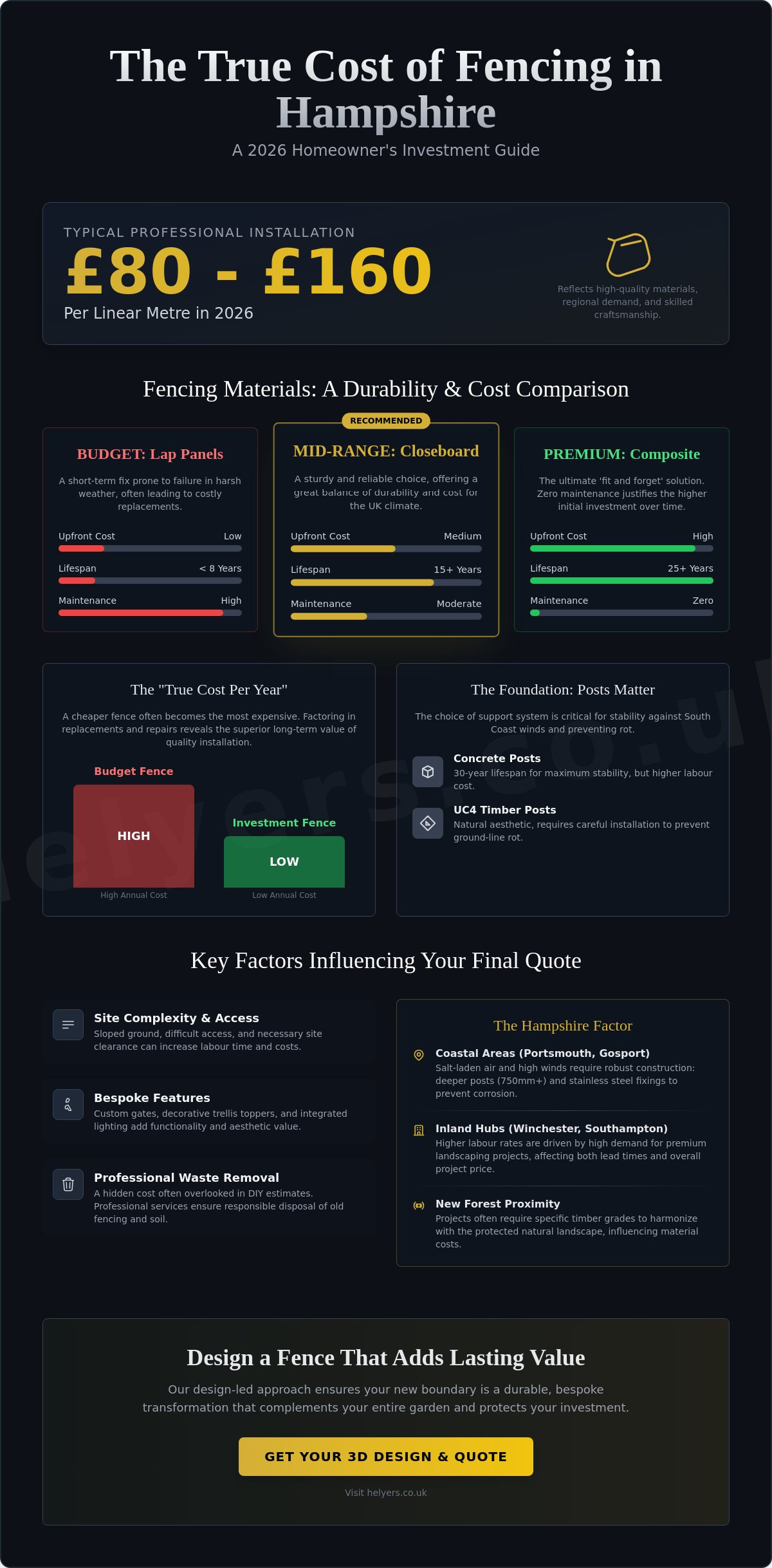
Calculating a realistic budget for your property requires an understanding of the local market and the specific environmental challenges of the South Coast. For 2026, professional installation rates in Hampshire typically range from £80 to £160 per linear metre. These figures reflect the rising costs of high-quality timber and the skilled labour required to meet Helyers’ standards of craftsmanship. While national averages might suggest lower figures, Hampshire homeowners often pay a premium due to the logistical costs of sourcing sustainable materials and the high demand for expert tradespeople in the region.
There’s a significant difference between purchasing materials for a DIY project and opting for a full-service design and build. A supply-only approach leaves you responsible for site clearance, waste disposal, and the physically demanding task of ensuring posts are perfectly level and secure. In contrast, Helyers manages the entire transformation, from the initial site survey to the final structural checks. A bespoke fencing installation serves as a durable property asset that provides security, privacy, and a measurable increase in market appeal.
The Hampshire Factor: Why Location Matters
Your specific postcode significantly influences your fencing cost hampshire. In coastal areas such as Portsmouth and Gosport, the combination of salt-laden air and high wind speeds necessitates more robust construction methods. We often specify deeper post-depths of at least 750mm and the use of stainless steel fixings to prevent corrosion. In inland hubs like Winchester and Southampton, labour rates are driven by a high volume of premium landscaping projects, which can affect lead times and pricing. Furthermore, homes near the New Forest often require specific timber grades that harmonize with the protected natural landscape, influencing both sourcing times and material expenses.
Basic vs. Premium: Setting Your Budget
The longevity of your fence depends heavily on the materials you select. Homeowners should evaluate different types of fencing based on their specific needs for privacy and aesthetics. Entry-level lap panels are cost-effective but rarely last beyond eight years in the British climate. Mid-range closeboard fencing offers a sturdier alternative, while premium slatted designs provide a contemporary look that transforms the garden’s atmosphere. When planning your fencing cost hampshire, remember to account for these essential elements:
- Gates and Hardware: Custom-built gates with heavy-duty hinges and secure locking mechanisms.
- Decorative Features: Trellis toppers for climbing plants or integrated lighting systems for evening ambiance.
- Longevity: Professional installation carries a higher initial cost but eliminates the cycle of frequent repairs associated with temporary DIY fixes.
Investing in professional craftsmanship ensures your perimeter remains standing after the first winter storm. Helyers focuses on delivering results that don’t just mark a boundary but enhance the overall value of your outdoor living space.
Comparing Fencing Materials: From Traditional to Contemporary
Choosing the right material is the single most influential factor in your total fencing cost hampshire. In the damp UK climate, where timber is frequently exposed to high moisture levels, durability ratings are vital. We recommend UC4-rated pressure-treated timber for any components in ground contact. This chemical treatment ensures the wood resists rot for 15 years or more, whereas standard dip-treated timber may begin to fail within 5 to 7 years. For homeowners seeking a permanent solution, Millboard and composite fencing have seen a 25% increase in local specifications since 2024. These materials require zero painting or staining, which justifies their higher initial price point through long-term maintenance savings.
The choice between support systems also impacts your 2026 project estimate. Concrete posts offer a 30-year lifespan and provide maximum stability against South Coast winds, though they carry a higher labor cost due to their weight. Pressure-treated timber posts offer a more seamless, natural aesthetic at a lower price, but they require careful installation with post-savers to prevent ground-line rot. Before finalizing your material choice, it’s essential to check planning permission for fences to ensure your chosen height and style comply with local Hampshire regulations, especially if your property borders a highway.
Traditional Closeboard and Lap Fencing
Closeboard remains the gold standard for privacy in Fareham gardens. It’s constructed from vertical feather-edge boards that overlap, creating a robust barrier that handles wind loads better than cheaper alternatives. While lap panels are the most budget-friendly option, they lack the structural integrity of a bespoke closeboard build. At Helyers, we prioritize tanalised timber over dip-treated variants to ensure your investment stands up to the elements. For a cohesive look, many clients pair these boundaries with matching fencing and gates to secure their property effectively.
Modern Slatted and Decorative Panels
For contemporary Hampshire homes, slatted fencing provides a sophisticated, architectural finish that allows light to filter through. Western Red Cedar is a premium choice due to its natural oils and rot resistance, though high-quality Douglas Fir offers a similar aesthetic at a more accessible price point. We often use these decorative panels to create distinct zones within larger estates, such as screening a patio or framing a kitchen garden. These modern styles significantly enhance curb appeal and can increase a property’s market value by providing a polished, designer feel.
If you’re unsure which material best suits your garden’s specific microclimate, contact Helyers for a professional site assessment and a detailed 2026 quotation.
Beyond the Panels: The Real Drivers of Installation Costs
Calculating the fencing cost hampshire homeowners face involves more than just measuring a boundary line. While a “price per foot” estimate provides a starting point, it rarely reflects the complexities of a professional installation. We find that site preparation and waste removal often constitute a significant portion of the final invoice. Clearing away decades of overgrown ivy or dismantling a collapsed timber structure takes time and physical effort. Disposing of this waste responsibly requires a registered carrier and skip hire, adding a necessary but often overlooked expense to the project budget.
Site logistics play a massive role in how we price our work. For instance, a project in a Portsmouth terraced house with no rear access requires us to hand-carry every component through the property. This increases labour time by approximately 25% compared to a site with wide side-access. When selecting your style, it’s wise to review a guide to popular fence materials to ensure your chosen panels suit the specific physical constraints of your garden. Where ground levels are uneven, we must install additional or bespoke gravel boards to step the fence correctly, ensuring the timber panels don’t touch the damp earth and succumb to rot.
Ground Conditions and Soil Types
The ground beneath your feet changes the way we build. In Fareham and the Meon Valley, the soil is often heavy clay. This type of earth holds water and shifts during seasonal changes, meaning we have to dig deeper and use more ballast to ensure the posts stay upright. In contrast, Winchester projects often involve flint or chalk-heavy soil. Digging through these layers is a slow process that requires heavy-duty tools and significant physical stamina. We don’t cut corners on foundations; deep-set posts are the only way to guarantee a durable result that stands up to high winds and shifting soil.
Access and Logistics
The layout of your property determines the man-hours needed for a successful transformation. If we can’t get a van or a trolley near the boundary, the team must move tons of material by hand. Steep or tiered garden boundaries also present unique challenges that require specialist equipment or bespoke structural supports. This is why we provide a detailed site survey before starting any work. If your boundary is particularly challenging, you may find that tiering a garden is a more effective long-term solution for managing steep slopes and creating a secure, aesthetically pleasing perimeter.
Maximising Your Investment: Longevity vs. Upfront Price
When assessing the fencing cost hampshire homeowners often focus on the initial quote. However, the true value of a boundary project is found in its lifespan. A budget fence costing £2,000 might fail within 6 years due to rot or storm damage, resulting in an annual cost of £333. In contrast, a £5,000 professional installation using premium materials and deeper footings can last 25 years. This reduces the long-term investment to just £200 per year. Choosing quality isn’t just about aesthetics; it’s a calculated financial decision that protects your property value.
Helyers prioritises structural integrity to combat the intense South Coast storms that frequently batter the region. Our team ensures that posts are set at a minimum depth of 600mm to provide a stable foundation against high wind speeds. We also advocate for integrated garden design. Instead of a piecemeal fence replacement, we look at how the boundary interacts with your entire landscape. Professional craftsmanship reduces your long-term liabilities by ensuring the structure remains safe and upright, preventing the need for emergency repairs after every gale.
Maintenance-Free Fencing Solutions
Composite fencing is becoming a standard choice for those who want to avoid the cycle of annual timber staining. While the initial material cost is higher, you save approximately £150 every year on oils and brushes, not to mention the hours of labour saved. Durapost systems are particularly effective in high-wind Hampshire corridors. These galvanised steel posts are tested to withstand 110mph gusts and won’t warp or crack like traditional timber. For most homeowners, these high-end materials pay for themselves within 7 years through eliminated maintenance costs.
Planning Permission and Legal Boundaries
Understanding the legal landscape is vital before work begins. In most Hampshire jurisdictions, you don’t need planning permission for a fence under 2 metres in height. If your property sits in a conservation area, such as parts of Winchester or Emsworth, stricter rules apply to the materials and styles you can use. Helyers provides professional surveys to identify exact boundary lines. This prevents the costly legal disputes that can arise from even a 10cm encroachment on a neighbour’s land. We ensure every project complies with local regulations from the start.
A well-installed fence is the backbone of a secure and beautiful home. If you want to understand the true fencing cost hampshire for your specific project, it’s best to speak with experts who know the local terrain.
Secure your property with a fence built to last. Contact Helyers for a professional fencing consultation today.
The Helyers Approach: Design-Led Fencing Installation
Helyers views a fence as more than a simple boundary. It’s a structural element that defines the character and privacy of your home. We integrate fencing into the wider landscape to ensure the final result feels like a natural extension of your property. Our 3D design process allows you to visualise how different heights, materials, and orientations impact light and space before the first post is even driven into the ground. This level of planning is a cornerstone of a successful garden design hampshire project, where every detail must work in harmony.
The Helyers guarantee is built on premium materials and the expertise of our local teams. We source timber that meets high durability standards to withstand the unpredictable British weather. Our business model focuses exclusively on high-end transformations and full installations. We don’t provide routine maintenance or minor repairs. This focus allows our specialist teams to dedicate their full attention to complex, high-specification projects that demand precision. When you evaluate the total fencing cost hampshire, this design-led approach ensures a long-term investment that enhances your property’s market value.
Serving the Entire Hampshire Region
Helyers operates across the county, providing bespoke solutions for homeowners in Fareham, Portsmouth, Southampton, and Winchester. We understand that a project in the New Forest requires a different aesthetic and structural approach than a garden in the Meon Valley or Petersfield. Our local knowledge of Hampshire weather patterns is vital. We account for coastal wind speeds and soil types when specifying post depths and fixings, ensuring your fence remains stable and attractive for years to come.
Getting Your Bespoke Fencing Quote
Transparency is a core value at Helyers. Our consultation process begins with a thorough site visit to assess ground conditions, access, and levels. Following this, we provide a detailed 3D plan and a fixed-price quote. We avoid vague estimates that lead to budget creep. Instead, we provide a definitive fencing cost hampshire residents can use for accurate financial planning. This straightforward approach builds trust and ensures we’re aligned on the project scope from day one.
- Initial site assessment and professional consultation
- Detailed 3D visualisations for design clarity
- Fixed-price quotes with no hidden extras
- Expert installation by Hampshire-based professionals
To begin your garden transformation, contact the Helyers team today. We’ll guide you through the options and help you create a boundary that offers security, privacy, and lasting beauty.
Secure Your Property with Professional Hampshire Fencing
Choosing the right boundary is a long-term investment in your home’s security and kerb appeal. Your total fencing cost hampshire depends on more than just the price of timber; it’s driven by material durability, local ground conditions, and the precision of the installation. Opting for high-quality components now prevents the need for expensive repairs after the next coastal storm. It’s a balance between upfront expenditure and the total life cycle of the fence.
Established in 2003, Helyers brings over 20 years of local expertise to every project. We’re a family-owned business operated by Richard Helyer, specializing in high-end transformations and bespoke 3D garden design. Our team doesn’t just install panels; we create structured outdoor environments that stand the test of time. We’ve spent two decades refining our craftsmanship to ensure every post and rail meets our exacting standards for quality and stability.
It’s time to move beyond standard solutions and choose a fence that truly complements your landscape. We’re here to guide you through every technical detail and design choice to ensure your investment is protected. Book your bespoke Hampshire fencing consultation with Helyers today. We look forward to helping you transform your garden.
Frequently Asked Questions
How much does a 6ft closeboard fence cost per metre in Hampshire?
A 6ft closeboard fence typically costs between £85 and £130 per linear metre for professional installation in Hampshire. This price range includes high-quality pressure-treated timber and standard labor charges for a level site. According to 2024 industry benchmarks, the final price depends on whether you choose wooden or concrete posts, with concrete options sitting at the higher end of the scale.
Does the cost of fencing include removing my old panels and posts?
Most professional quotes treat the removal and disposal of old fencing as a separate line item rather than an included service. You can expect to pay between £20 and £35 per bay for dismantling and responsible waste disposal at a licensed facility. Helyers ensures all old materials are recycled where possible, keeping your garden clear and ready for the new installation without hidden disposal fees.
How long should a professionally installed fence last in the UK climate?
A professionally installed fence using pressure-treated timber should last between 15 and 25 years in the UK climate. Using gravel boards to prevent ground contact significantly extends this lifespan by protecting the base from moisture. Regular maintenance, such as applying a UV-resistant treatment every 2 to 3 years, helps the wood withstand Hampshire’s seasonal weather shifts and prevents premature rot.
Do I need planning permission for a 2-metre high fence in Winchester?
You generally don’t need planning permission for a fence up to 2 metres high in Winchester, provided it isn’t next to a highway. If the boundary faces a road or footpath used by vehicles, the height limit drops to 1 metre under UK building regulations. Always check with Winchester City Council if your property is a listed building or sits within a conservation area, as 100% of these cases require specific consent.
Why is cedar fencing so much more expensive than standard pressure-treated timber?
Cedar fencing costs more because it contains natural oils that act as a built-in preservative against rot, decay, and insect attacks. This eliminates the need for chemical pressure treatments and provides a natural lifespan exceeding 30 years. Its superior stability means the wood is 50% less likely to warp or shrink compared to standard pine or larch alternatives, making it a premium choice for bespoke projects.
What happens to fencing costs if my garden is on a steep slope?
Installing a fence on a steep slope can increase total project costs by 15% to 25% due to the additional labor required for “stepping” the panels. Each post must be custom-set to maintain a level top line while following the garden’s gradient. This process often requires longer posts and extra concrete to ensure the structure remains stable against Hampshire’s wind loads, requiring more material than a flat installation.
Can I install a new fence during the winter months in Hampshire?
You can absolutely install a new fence during the winter months, and it’s often a practical time to secure your boundary before spring. While frozen ground or heavy rain can slightly slow the digging process, professional teams use specialized equipment to ensure posts are set correctly. Booking a winter installation helps you avoid the peak season rush for a better fencing cost hampshire experience while protecting your garden through the storm season.
Is it cheaper to use concrete or wooden posts for a new garden boundary?
Wooden posts are roughly 30% cheaper to purchase and install initially, making them a budget-friendly choice for immediate savings. However, concrete posts offer better long-term value because they don’t rot and can last over 40 years. Choosing concrete reduces your future fencing cost hampshire by removing the need for post replacements every decade, especially in damp soil conditions common across the region.