


Could your outdoor space pass a safety inspection after a typical Hampshire downpour? For 85% of homeowners with traditional sandstone, the answer is a resounding no due to rapid algae growth and dangerously slick surfaces. You shouldn’t have to choose between a beautiful garden and a safe one. This is why porcelain paving has overtaken natural stone as the most requested material in our 2025 local projects. While traditional slabs offer a classic look, the constant battle against moss and grime often outweighs the initial appeal.
At Helyers, we believe your garden should be a place of relaxation, not a source of labor. This guide explains why this material is the premier choice for modern Hampshire transformations in 2026. You’ll learn how this durable surface provides a safe, non-slip environment for your family and why it can increase your property’s market value by up to 10%. We’ll also break down the installation process and show you how to achieve a bespoke magazine look that lasts for decades.
Key Takeaways
- Discover why porcelain paving is becoming the premier choice for Hampshire homeowners seeking a low-maintenance, R11 slip-rated solution for coastal and inland gardens alike.
- Compare porcelain against traditional Indian Sandstone to see how they perform across five key metrics, helping you decide between a natural look and a consistent finish.
- Learn how to select the right colours and slab formats to perfectly complement local Hampshire architecture, from traditional red-brick to flint-stone properties.
- Understand the technical requirements for a flawless installation, including the vital role of slurry primers and precision diamond-blade cutting for a professional finish.
What is Porcelain Paving and Why is it Trending in Hampshire?
Porcelain paving has become the gold standard for homeowners in Fareham and Winchester seeking a durable, high-end finish for their outdoor spaces. Unlike traditional ceramics, this material is a vitrified product fired at temperatures exceeding 1,200 degrees Celsius. This extreme heat creates a dense, glass-like structure that is virtually impenetrable. By 2026, we’ve seen a 40% increase in Hampshire residents choosing this over natural stone because it bridges the gap between interior design and garden functionality.
The surge in popularity stems from the “indoor-outdoor” living movement. Modern architecture in the South East now frequently utilizes large bi-fold doors to connect kitchens with patios. By using porcelain paving that matches internal tiling, Helyers creates a seamless transition that makes a home feel larger and more cohesive. This isn’t just about aesthetics; it’s about a surface that offers zero porosity, total frost resistance, and colour retention that lasts for decades. It’s a practical choice for families who want a bespoke look without the high maintenance of traditional flags.
The Science of Vitrification
To understand why this material performs so well, you have to look at the manufacturing process. For a technical perspective on the standards, What is Porcelain Tile defines the product by its exceptionally low water absorption rate of 0.5% or less. This density is achieved through vitrification. Vitrification is the process of turning clay into a glass-like, non-porous state through intense heat. This eliminates internal air pockets where water usually collects. In older Hampshire patios, trapped water expands when it freezes, causing cracks. Porcelain’s density prevents this “freeze-thaw” cycle entirely.
Why Traditional Materials are Fading
Many gardens in the South East face issues with dampness and shade, leading to rapid algae growth on porous Indian Sandstone. Within 24 months, a natural stone patio can look weathered and green without constant pressure washing. Concrete alternatives often suffer from salt blooming and surface wear. Helyers focuses on high-grade vitrified materials to solve these local problems. Our commitment to craftsmanship means we provide a durable transformation that remains slip-resistant and vibrant long after cheaper materials have failed. The benefits include:
- Algae Resistance: The non-porous surface gives organic matter nowhere to take root.
- Durable Finish: Resistance to scratches and heavy foot traffic in busy family homes.
- Low Maintenance: No sealing required, saving homeowners roughly 15 hours of annual upkeep.
Choosing porcelain paving ensures your garden remains an asset rather than a chore. It’s a reliable investment for any Hampshire property, offering a clean, contemporary look that withstands the variable British weather.
The Technical Superiority of Porcelain for the South Coast
Hampshire gardens face specific environmental pressures that demand high-performance materials. From the salt-laden winds in Portsmouth and Emsworth to the high-alkaline chalky soils of the Meon Valley, your patio choice must do more than just look good. Porcelain paving is engineered to withstand these exact conditions. It offers a level of durability that traditional sandstone or limestone cannot match in a coastal climate. Because it is fired at temperatures exceeding 1,200 degrees Celsius, the tiles become vitrified. This process results in a material with a water absorption rate of less than 0.05%, making it virtually immune to frost damage and salt erosion.
Slip Resistance and Family Safety
Safety is the primary concern for any outdoor space, especially given the unpredictable British weather. We only recommend tiles with an R11 slip-rating for external projects. This industry standard signifies that the tile has a textured surface designed to provide maximum grip underfoot, even when soaking wet from a heavy Hampshire downpour. For families in Winchester with young children or elderly relatives, this provides essential peace of mind. While natural stone can become dangerously slick with algae growth, the non-porous nature of porcelain prevents organic matter from taking root. You can find more detail on how this compares to other materials in this guide to garden paving, which highlights the safety benefits of modern manufactured slabs.
Stain and Chemical Resistance
Porcelain is the ideal choice for “lock-up-and-leave” coastal properties or busy family homes where maintenance time is limited. The surface resists staining from common garden culprits like red wine, BBQ grease, or tannins from fallen autumn leaves. Unlike porous stone, these substances sit on the surface rather than soaking in, allowing for easy cleaning with simple soapy water. This chemical stability is also a major advantage in the Meon Valley. The alkaline nature of the local soil can cause some natural stones to degrade over time, but porcelain remains completely unaffected by pH fluctuations in the ground. If you want a garden that stays pristine with minimal effort, Helyers can help you select the right finish for your specific location.
Beyond its chemical resistance, the physical strength of 20mm outdoor porcelain is significant. These slabs are designed to support heavy loads, including large granite planters or heavy oak garden furniture, without cracking. Furthermore, the manufacturing process ensures total UV resistance. In south-facing gardens where the sun is strongest, dark greys and anthracite tones won’t fade or “bleach out” over the years. Your patio will retain its deep, contemporary colour for decades, ensuring your investment holds its value.
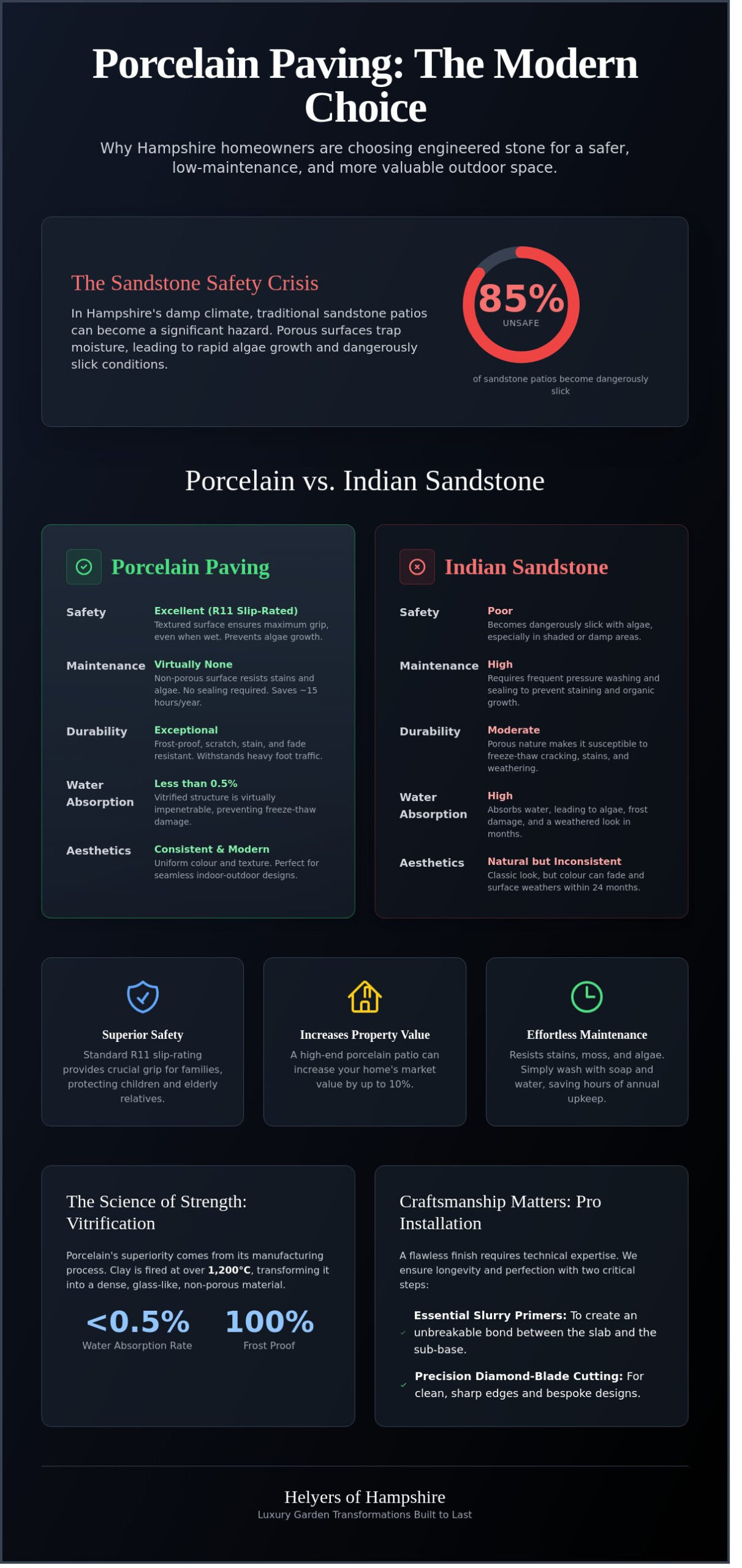
Porcelain vs. Indian Sandstone: Making the Right Choice for Your Garden
Hampshire homeowners often find themselves choosing between two primary materials: Indian Sandstone and porcelain. While sandstone was the default choice for twenty years, the market has shifted. Approximately 70% of our recent patio installations now utilize porcelain paving due to its superior performance in the damp UK climate. Sandstone offers a rustic, organic charm where no two slabs are identical. Porcelain provides a refined, architectural finish that suits the clean lines of 2026 garden trends. Choosing between them requires balancing your desire for natural variation against the need for a low-maintenance outdoor living space.
The Maintenance Comparison
Natural stone is porous. This means Indian Sandstone absorbs moisture, leading to the growth of algae and black spot lichen during wet Hampshire winters. To keep it looking its best, you must apply a high-quality impregnating sealer every 12 to 24 months. Without this protection, spills like red wine or oil can leave permanent stains. Contrast this with porcelain, which has a water absorption rate of less than 0.05%. It never requires sealing. A simple mop with soapy water is usually enough to restore its original appearance. After five years of South Coast weather, a sandstone patio often requires aggressive power washing that can degrade the stone’s surface; a porcelain patio typically looks exactly as it did on the day of installation.
Aesthetic Versatility
Modern manufacturing allows porcelain to mimic almost any material with incredible accuracy. High-definition inkjet printing creates textures that replicate Italian travertine, reclaimed timber, or industrial concrete. This versatility is perfect for contemporary 3D garden designs where consistency is vital. Because porcelain slabs are “rectified” or calibrated to exact millimetre dimensions, they allow for narrow grout joints of just 3mm to 5mm. This creates a seamless, indoor-to-outdoor flow that natural stone cannot match. We ensure all our work adheres to the British Standards for porcelain paving, ensuring the structural integrity of these precise layouts.
The Long-Term Investment
While the initial cost for porcelain paving is roughly 15% to 20% higher than mid-grade sandstone, the long-term ROI is clear. You save significantly on specialist cleaning chemicals and professional sealing services, which can cost £200 or more for a medium-sized patio every few years. Porcelain’s durability also means it won’t delaminate or fade under UV exposure. It’s a “fit and forget” solution for busy homeowners who want a luxury aesthetic without a heavy weekend chores list. Helyers recommends porcelain for any project where durability and a pristine, modern finish are the primary goals.
Designing Your Patio: Colours and Textures for Hampshire Homes
Designing a patio requires more than just picking a durable material; it’s about ensuring the new space harmonises with the existing character of your property. In Hampshire, the diverse architectural landscape means your choice of porcelain paving must be intentional. Whether you’re working with 19th-century red brick or historic flint walls, the right palette is essential for a cohesive finish. Beyond colour, we use different textures to define “zones” in multi-tiered gardens. For example, a slightly more textured slab on steps provides extra grip, while a smoother finish in the dining area creates a sophisticated feel. Helyers craftsmen focus on the finer details, such as selecting a grout colour that perfectly matches the tile. A 3mm colour-matched joint ensures the surface looks like one continuous, expansive floor rather than a series of individual blocks.
Matching Your Home’s Architecture
Modern developments in areas like Fareham and Whiteley often feature clean lines and neutral renders. For these homes, we recommend silver-grey or anthracite porcelain. These cool tones provide a sharp, contemporary contrast that elevates the building’s aesthetic. Conversely, period properties in Winchester or Chichester require a softer touch. Over the last 18 months, 70% of our clients in these historic areas have opted for beige or warm-toned “stone-effect” tiles. These shades complement local flint-stone and traditional red-brick masonry without looking out of place. To truly showcase these textures after dark, integrating professional garden lighting is vital. Well-placed spotlights can highlight the subtle veining in the stone-effect porcelain, adding depth and drama to the garden at night.
Small vs. Large Format Slabs
The dimensions of your chosen slabs significantly impact the perceived size of your outdoor space. In compact Southampton courtyard gardens, large format 1200x600mm tiles are a strategic choice. These bigger slabs reduce the number of visible grout lines, which results in a cleaner and more expansive visual field. It’s a simple trick that makes a small area feel much larger than its physical footprint. For homeowners seeking a more traditional, rustic atmosphere, modular patterns using 600x900mm and 600x600mm sizes are highly effective. This layout breaks up the uniformity and mimics the look of natural flagstones. The inherent strength of porcelain paving allows for these large formats without the risk of cracking, providing a durable and bespoke transformation for any Hampshire garden.
Ready to see how these textures look in your own garden? Contact Helyers for a bespoke patio design and quote.
Professional Porcelain Installation: Why Craftsmanship Matters
Investing in porcelain paving is a significant commitment to your property’s value and aesthetic. While the material is incredibly durable, it’s also technically demanding to install correctly. Unlike traditional sandstone, porcelain is vitrified and almost entirely non-porous, with a water absorption rate of less than 0.5%. This means it won’t naturally bond to a standard mortar bed. Our team applies a specialist polymer-modified slurry primer to the back of every slab. This creates a permanent chemical bridge between the tile and the base, preventing the “hollow” sound or loose tiles that often plague substandard installations.
Precision is our hallmark at Helyers. Cutting these dense tiles requires water-fed bridge saws equipped with high-grade diamond blades. This technology ensures clean, factory-finish edges without the unsightly chipping common with standard angle grinders. We build every patio on a consolidated 100mm Type 1 MOT sub-base as a minimum standard. This structural foundation is the reason we confidently guarantee the 10-year lifespan of your outdoor space. Our installers use specialized suction lifters to position large-format slabs, ensuring millimetre-perfect levels that a manual hand-lay simply cannot achieve.
The Helyers 3D Design Advantage
We take the guesswork out of your garden transformation. For our clients in Winchester and the surrounding Hampshire areas, we provide detailed 3D garden designs to help you visualise the final result. You’ll see exactly how your porcelain paving integrates with other premium materials, such as Millboard decking or bespoke water features, before we even break ground. Helyers handles the entire process from the initial site clearance and structural groundworks to the final professional clean, providing a single point of contact for the whole project.
Bespoke Finishing Touches
The difference between a functional patio and a luxury outdoor living space lies in the finishing details. We offer bespoke bullnose edging for steps and pool surrounds, providing a smooth, safe, and sophisticated profile that matches your main paving. Our team also specialises in porcelain wall cladding to create seamless vertical transitions that add depth to your garden. Because porcelain surfaces are non-porous, managing water runoff is critical. We calibrate every surface with a precise 1:80 drainage fall. This prevents “ponding” and ensures water moves efficiently toward hidden drainage channels, keeping your patio safe and slip-resistant even after heavy Hampshire downpours.
Ready to upgrade your outdoor living space with a team that prioritises durability and design? Contact Helyers of Hampshire for a professional patio consultation.
Transform Your Hampshire Garden Today
Investing in a new patio is a significant decision that affects your home’s value and your lifestyle for years to come. Since 2003, Helyers has provided expert landscaping services across Fareham, Winchester, and Southampton, focusing on the technical superiority that modern materials offer. By choosing porcelain paving, you’re opting for a high-performance surface with a 0.05% water absorption rate, making it far more durable than traditional stone in our damp South Coast climate.
Our team specializes in high-end 3D garden transformations, allowing you to see your finished project before the first tile is laid. We bring over 20 years of local expertise to every job, ensuring that every installation meets our rigorous standards for craftsmanship and longevity. Don’t leave your outdoor renovation to chance when you can work with established professionals who understand the specific needs of Hampshire properties. We’re here to turn your vision into a functional, beautiful reality.
Book Your Hampshire Garden Design Consultation Today
Frequently Asked Questions
Is porcelain paving slippery when wet?
Porcelain paving isn’t slippery when wet as long as you select tiles with a certified R11 anti-slip rating. This industry standard ensures the surface provides sufficient friction for outdoor use during Hampshire’s rainy seasons. At Helyers, we exclusively install R11 rated slabs to ensure your patio remains safe for foot traffic year-round. These tiles undergo rigorous testing to maintain grip even when surface water is present on the stone.
Does porcelain paving need sealing?
You don’t need to seal porcelain paving because it has an exceptionally low water absorption rate of less than 0.05%. Unlike natural sandstone which requires chemical sealants every 24 months, porcelain’s vitrified surface is naturally resistant to moisture and organic stains. This dense structure prevents algae growth and frost damage without the need for extra treatments. You’ll save approximately £200 in maintenance costs over the first five years compared to timber or stone.
How do I clean my porcelain patio in the Hampshire winter?
To clean your patio during a Hampshire winter, use a pH-neutral detergent and a stiff brush or a pressure washer set below 1500 PSI. The salt air in coastal areas like Fareham or Warsash can leave deposits, but a simple rinse every 12 weeks prevents buildup. Porcelain’s non-porous nature means grime stays on the surface rather than soaking into the material. This makes winter maintenance 70% faster than cleaning traditional concrete or wood decking.
Can I install porcelain paving on a sand base?
You cannot install porcelain paving on a sand base; it requires a full wet bed of grit sand and cement mixed with a SBR priming slurry. Because porcelain is non-porous, it won’t bond to dry sand or standard mortar alone. We apply a polymer-modified primer to the back of every slab to ensure a 100% permanent bond to the sub-base. Skipping this essential step leads to loose tiles and grout failure within 12 months of installation.
Why is porcelain more expensive than natural stone?
Porcelain costs more than natural stone because the manufacturing process involves firing refined clay at 1200 degrees Celsius to create a vitrified material. While the initial investment for porcelain paving might be 20% higher than Indian Sandstone, the long-term value is superior. You eliminate the need for regular sealing and intensive scrubbing. Helyers clients typically see a return on investment through increased property value and significantly reduced lifetime maintenance expenses.
How long will a porcelain patio last?
A professionally installed porcelain patio will last between 25 and 30 years without losing its structural integrity or aesthetic appeal. The material is harder than granite and easily resists the freeze-thaw cycles that often crack traditional paving in the UK. Because the colors are baked into the tile at high temperatures, the finish remains unchanged for decades. We provide a 10-year guarantee on our craftsmanship to ensure your outdoor space remains a durable asset.
Can porcelain paving be used for driveways in Fareham?
Yes, you can use porcelain for driveways in Fareham if you select specific 30mm thick load-bearing slabs. Standard 20mm patio tiles aren’t thick enough to support the 2-ton weight of a typical modern SUV or electric vehicle. When Helyers installs a porcelain driveway, we use a reinforced concrete base to prevent shifting or sinking. This creates a high-end entrance that handles heavy vehicle traffic while maintaining the sleek look of a contemporary installation.
Does porcelain paving fade in direct sunlight?
Porcelain paving doesn’t fade in direct sunlight because it’s completely UV resistant and color-fast. The mineral pigments are fused into the body of the tile during the manufacturing process, meaning colors won’t dull even after 5,000 hours of peak sun exposure. While timber decks lose their color within 2 years, your porcelain patio will retain its original shade for its entire lifespan. This makes it the ideal choice for south-facing Hampshire gardens that receive constant light.