


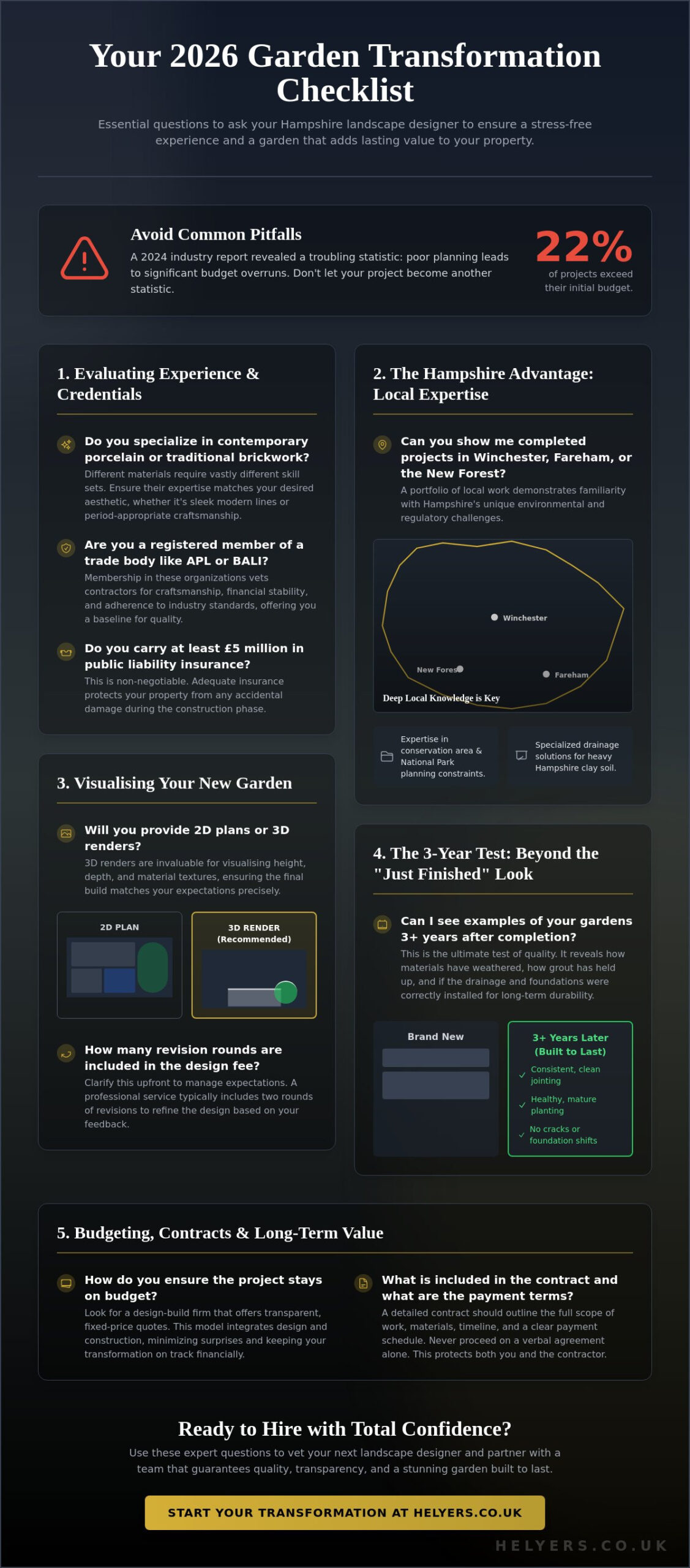
What if your £15,000 garden investment looks stunning in July but begins to fail after its first Hampshire winter? It’s a common fear for homeowners who worry that hidden costs or unsuitable materials might ruin their vision. We agree that your outdoor space should be a durable, high-quality extension of your home. A 2024 industry report indicated that 22% of UK landscaping projects exceed their initial budget due to poor planning. Securing a successful result starts with knowing the right questions to ask your landscape designer before any work begins.
At Helyers, we believe that a total transformation relies on transparency and expert craftsmanship. We’ve developed this 2026 checklist to help you eliminate confusion over material durability and build quality. By asking these 15 expert-vetted questions, you’ll ensure a stress-free experience and a garden that adds significant value to your property. This guide provides a clear look at how to vet contractors for everything from drainage solutions to project timelines so you can hire with total confidence.
Key Takeaways
- Discover how to vet a designer’s regional expertise in areas like Winchester and Fareham to ensure your garden thrives in Hampshire’s specific conditions.
- Learn the essential questions to ask your landscape designer regarding 3D renders and revision rounds to ensure the final bespoke design matches your vision perfectly.
- Gain insights into managing technical challenges, such as handling surface water on clay-heavy soil and selecting durable materials suited to the damp South Coast climate.
- Understand the benefits of the design-build model and how to secure transparent, fixed-price quotes to keep your garden transformation on track and within budget.
Evaluating Experience: Questions for Your Initial Consultation
Choosing a professional to redesign your outdoor space is a significant investment that requires more than just a quick glance at a social media gallery. When preparing your list of questions to ask your landscape designer, start by verifying their technical capability and local reputation. You need to know if they specialize in contemporary porcelain patios or traditional brickwork, as these require different skill sets and installation methods. A designer who excels at sleek, modern lines might not be the right fit for a period property requiring reclaimed materials and intricate mortar joints.
Professional credentials provide a baseline for quality and safety. Ask if they are a registered member of a recognized trade body, such as the Association of Professional Landscapers (APL) or the British Association of Landscape Industries (BALI). These organizations vet their members for craftsmanship and financial stability. Ensure they carry adequate public liability insurance, typically at least £5 million, to protect your property during the construction phase. Understanding What is Landscape Design? involves recognizing that it is a technical discipline requiring both artistic vision and structural engineering knowledge.
The Importance of Local Hampshire Knowledge
Hampshire presents unique challenges that a non-local designer might overlook. You should ask if they have completed similar projects in Winchester, Fareham, or the New Forest recently. Experience with Hampshire’s specific clay soil is vital, as this heavy ground requires specialized drainage solutions and reinforced foundations to prevent movement. Specifying the correct sub-base depth on Hants clay prevents foundation failure and ensures your paving remains level for decades regardless of seasonal shifts.
Local expertise also extends to planning constraints. If your home is in a Winchester conservation area or within the New Forest National Park, strict regulations govern the materials and structures you can install. A designer familiar with these local authorities can streamline the approval process and prevent costly legal issues later.
Portfolio Deep-Dive: Beyond the “Just Finished” Look
A portfolio of brand-new gardens can be misleading. Ask to see examples of established gardens three years after completion. This allows you to see how the materials have weathered and how the planting scheme has matured. A garden that looks excellent in a “just finished” photo might suffer from drainage issues or failing grout after two harsh UK winters.
Question the designer on how they handled specific site challenges in past local projects, such as steep gradients or north-facing plots. This ensures your bespoke garden transformation isn’t just a temporary facelift but a permanent, durable improvement to your home. Look for evidence of:
- Consistent jointing quality in stone and porcelain.
- Healthy, established planting that hasn’t overgrown its space.
- Retaining walls that show no signs of bowing or cracking.
- Effective integration of lighting and irrigation systems.
By focusing on longevity rather than immediate aesthetics, you’ll identify a partner who prioritizes high-quality craftsmanship and long-term results.
The Design Process: How Will You Visualise My New Garden?
A garden transformation is a significant investment, so you need to be certain the final result matches your vision. Professional designers use various tools to bridge the gap between a conceptual idea and a finished build. One of the most important questions to ask your landscape designer is how they intend to present their proposals to you. Clear visualisation prevents misunderstandings and ensures the craftsmanship meets your expectations before a single spade hits the dirt.
- Visualisation format: Ask if they provide traditional 2D sketches or advanced 3D garden design renders. While 2D plans are useful for layout, 3D models offer a realistic perspective of heights and depths.
- Revision rounds: Clarify how many sets of changes are included in the initial design fee. Most professional agreements include two rounds of revisions to refine the layout based on your feedback.
- Regional planting plans: Ensure the design includes a detailed planting schedule tailored to the South Coast. Hampshire gardens often deal with specific challenges like chalky soil or salt-heavy winds in coastal areas.
- Technical integration: Confirm if the design accounts for outdoor electrical systems and lighting from the outset. Retrofitting cables after a patio is laid is costly and disruptive.
3D Design: Seeing the Results Before You Dig
3D modelling has become a vital tool for high-end Hampshire garden projects. These renders allow you to understand the true scale of the space and how light moves across the garden throughout the day. You can see exactly how a new pergola might cast shadows over your seating area at 6 PM in mid-August. This level of detail helps with accurate material estimation and prevents expensive mid-build changes. Ask your designer, “Can I take a virtual walkthrough of the space?” to get a real sense of the movement and flow between different zones.
Integrating Hardscaping and Softscaping
A successful garden requires a careful balance between structural elements and living plants. Your designer should explain how they’ll pair durable porcelain patios with sustainable, bee-friendly planting schemes that thrive in local conditions. If you’re considering decking, ask about the 25-year lifespan of Millboard composite versus traditional timber, which often requires annual maintenance in our damp climate. Every bespoke design should also incorporate structural security, such as professional fencing and gates, to frame the new landscape perfectly. If you’re ready to see how your space could look, the team at Helyers can help you plan your garden transformation with expert precision.
Technical Expertise: Addressing Hampshire’s Unique Landscape
Hampshire’s geology varies significantly, from the chalk of the South Downs to the heavy clay found in the Meon Valley. When interviewing potential partners, one of the most vital questions to ask your landscape designer is how they plan to manage these site-specific technical hurdles. A beautiful design will quickly fail if it doesn’t account for the physical realities of the local environment.
Drainage and SuDS Compliance
Clay-heavy soil in areas like Eastleigh or Hedge End frequently leads to surface water pooling during the winter months. You need to know exactly how a contractor will handle runoff to prevent your lawn from becoming a bog. Sustainable Drainage Systems (SuDS) are a sequence of management practices and control structures designed to drain surface water in a sustainable manner. This is a legal requirement for Hampshire driveway contractors when installing non-permeable surfaces over 5 square metres. Ask your designer how they’ll vet the water table on your property before they begin excavations.
Material Selection for the South Coast
The damp South Coast climate demands specific materials that can withstand moisture and salt air. While natural sandstone is a traditional choice, it can be prone to heavy algae growth and become slippery in shaded Hampshire gardens. Porcelain is often a superior alternative because it has a water absorption rate of less than 0.05%, making it frost-proof and naturally slip-resistant. In towns like Fareham and Chichester, resin-bound driveways have become a popular, permeable choice that meets modern SuDS regulations while providing a smooth, durable finish. If your design includes artificial grass or composite decking, check the UV stability ratings. Hampshire receives between 1,600 and 1,800 hours of sunshine annually; you need materials that won’t fade or warp under consistent exposure.
Structural Integrity and Planting for Longevity
Hampshire’s undulating terrain often requires significant changes in level to create usable space. You must ask how the contractor ensures retaining walls and tiered gardens are built to last, specifically regarding the depth of footings and the management of hydrostatic pressure. For coastal properties in Portsmouth or Southampton, salt air is a primary concern for any planting scheme. Standard inland species often wither in these conditions. Ask for a bespoke planting plan that includes salt-tolerant varieties like Olearia or Griselinia. These species thrive in maritime environments and ensure your garden remains a long-term asset rather than a constant maintenance burden.
From Design to Construction: Managing the Transformation
The transition from a 3D render to a physical garden is where the most critical questions to ask your landscape designer arise. You need to know exactly how the build phase operates to avoid hidden costs or logistical delays. Start by asking about the “Design-Build” model. Some firms only provide drawings and then sub-contract the heavy lifting to third parties. This often leads to a communication gap where the artistic vision gets lost during the groundworks phase.
A realistic lead time is another vital factor. In the 2026 Hampshire market, high-quality firms typically have a lead time of 12 to 20 weeks for major transformations. If a contractor can start “tomorrow,” it’s a red flag regarding their current demand and stability. You should also confirm how they handle waste. Removing 20 tonnes of Hampshire clay soil requires a coordinated “muck away” strategy, especially in tight residential streets where skip placement is restricted.
The Advantage of In-House Landscaping Teams
Helyers employs in-house landscaping teams to maintain total control over the craftsmanship. When the designer and the builder work for the same company, accountability is absolute. This setup ensures the 3D design is executed with millimetre precision because the build team is already familiar with the technical specifications. You should ask: “How do you handle unforeseen structural issues discovered during excavation?” In our region, we frequently encounter Victorian-era drainage or unexpected chalk deposits. An in-house team resolves these problems immediately without waiting for third-party approvals.
Minimising Disruption to Your Home
Construction is messy, but it shouldn’t be chaotic. A professional team respects your property and your neighbours. Ask about the daily point of contact; you deserve a dedicated site foreman who knows your project’s history. We recommend establishing clear boundaries from day one:
- Working hours: Standard 08:00 to 17:00 shifts respect local noise ordinances.
- Site cleanliness: Tools must be stored safely and driveways swept at the end of every day.
- Communication: Demand weekly progress updates to track the shift from heavy construction to the final planting phase.
This methodical approach ensures the transformation is a positive experience rather than a source of stress. If you’re ready to move from ideas to reality, book a consultation with Helyers to discuss your garden project.
Budgeting, Contracts, and Long-Term Value
Financial clarity is the foundation of a successful transformation. Before any soil is moved, you need to understand exactly where your investment goes. The final set of questions to ask your landscape designer should focus on the transition from a creative concept to a binding agreement. You don’t want surprises halfway through the build.
- Fixed Price vs. Estimates: Always ask if the quote is a fixed price or a variable estimate. While material costs can shift, a professional firm provides a detailed breakdown that holds firm under agreed conditions.
- Payment Milestones: Reliable contractors never ask for 100% upfront. A standard schedule might include a deposit to secure the date, followed by stage payments as materials arrive and specific milestones are met.
- Warranties: Look for a minimum of a five year structural guarantee on hard landscaping. This ensures the integrity of walls, patios, and drainage remains intact long after the team leaves.
Understanding the Investment
A garden is a significant asset. Professional paving contractors in Hampshire justify their pricing through the quality of what you cannot see. While a cheaper quote might cut corners on sub-base depth, a Helyers installation relies on industry-standard MOT Type 1 foundations to prevent sinking or cracking. When you review your quote, ensure it separates design fees, material costs, and labour. If the total exceeds your immediate reach, ask: “What are the most effective ways to phase this project if I have a set annual budget?” This allows you to complete the structural work first and add bespoke planting or lighting in a second phase.
Protecting Your Garden’s Future
The relationship shouldn’t end when the last slab is laid. Request a comprehensive handover pack that includes care instructions for your specific stone type and a seasonal maintenance schedule for new plants. This is vital for maintaining the high-quality look of your outdoor space. In areas like Fareham, where coastal air or heavy clay soil can impact materials, choosing the right durable finishes is essential. Low-maintenance designs often involve porcelain paving and automated irrigation, which save hours of weekend work.
Finally, consider the financial return. Ask your designer: “How will this design improve my property value in the current Hampshire market?” A well-executed garden transformation can increase a property’s market value by up to 20 percent, making it one of the most practical home improvements you can commission. By choosing a partner who prioritises craftsmanship and transparency, you ensure your garden remains a life-enhancing space for decades.
Start Your Hampshire Garden Transformation Today
Choosing the right partner for your outdoor project requires more than a quick glance at a portfolio. By using these essential questions to ask your landscape designer, you’ll gain the clarity needed to ensure your investment delivers long-term value. Since 2003, Helyers of Hampshire has served as a family-owned specialist; we provide a seamless design-to-build service that covers every stage of the transformation. We use expert 3D visualisation technology to bring your garden to life before construction begins, which allows you to refine details with absolute precision. Our team understands the unique challenges of Hampshire’s geography and soil, ensuring your bespoke space is as durable as it is beautiful. Don’t settle for guesswork when it comes to your home’s exterior. Take the first step toward a professionally managed garden that reflects your lifestyle and enhances your property’s character.
Book your bespoke 3D garden design consultation with Helyers of Hampshire today
Frequently Asked Questions
How much should I expect to pay for a garden design in Hampshire?
Professional garden design fees in Hampshire typically range between £800 and £3,000 for a master plan, depending on the size and complexity of your site. Most homeowners should budget approximately 10% to 15% of their total project cost for the design and technical drawing phase. This investment covers essential surveys and detailed layouts that prevent costly errors during construction. Helyers provides transparent, fixed-price quotes for our design services to help you manage your investment effectively.
Do I need planning permission for my landscaping project in Winchester or the New Forest?
Most residential landscaping falls under permitted development, but specific restrictions apply in the New Forest National Park and Winchester’s 37 conservation areas. You generally need planning permission if you’re installing a fence over 2 metres high or adding significant hardstanding that doesn’t use permeable materials. Listed buildings always require consent for any external changes. We recommend checking with the South Downs National Park Authority for projects in protected Hampshire rural zones to ensure total compliance.
What is the difference between a garden designer and a landscaper?
A garden designer focuses on the creative vision, spatial planning, and horticultural selection, while a landscaper handles the physical construction and groundworks. Designers produce the technical blueprints and 3D renders that guide the transformation. Landscapers use these plans to install paving, drainage, and structures. Helyers provides both services as a single, integrated team. This approach eliminates communication gaps between the drawing board and the site, ensuring the final build matches your original vision.
How long does a typical garden transformation take from design to completion?
A full garden transformation usually takes between 12 and 24 weeks from the initial consultation to the final planting. The design phase often requires 4 to 8 weeks to allow for site surveys and revisions. Once construction begins, a medium-sized Hampshire garden typically takes 3 to 6 weeks of on-site work. Weather conditions and material lead times can influence these dates. We provide a clear project schedule before we start, so you know exactly when your new space will be ready.
Can a landscape designer help if I only want to change my driveway or patio?
Yes, landscape designers are frequently hired for specific upgrades like bespoke patio installations or driveway renovations. These projects require careful technical planning regarding SuDS (Sustainable Drainage Systems) regulations and load-bearing requirements. One of the vital questions to ask your landscape designer is how they plan to manage water runoff on your property. We apply the same level of craftsmanship to a single patio as we do to a full garden, ensuring the new feature enhances your home’s value.
Is 3D garden design worth the extra investment for a small garden?
3D garden design is highly beneficial for small spaces because it allows you to visualize how different levels and structures affect the feeling of space. In a compact Hampshire courtyard, every 10 centimetres of space matters. A 3D render shows you exactly how shadows fall at different times of day, which is 100% more accurate than a flat 2D plan. This technology helps you make confident decisions about expensive materials before any physical work begins on your property.
What happens if I don’t like the initial design concepts?
We include specific revision stages in our process to ensure the final plan aligns with your expectations. Most professional design agreements allow for two rounds of adjustments after the first concept presentation. It’s helpful to have a list of questions to ask your landscape designer during the briefing stage to align on your style and budget early. We listen to your feedback and refine the layout or materials until the design feels right for your lifestyle and Hampshire home.
How do I check if a Hampshire landscape designer is properly insured?
You should request a copy of their current Public Liability Insurance certificate, which should provide a minimum of £5 million in coverage for residential projects. Professional Indemnity Insurance is also essential for the design portion of the work. Check if the company is a member of the British Association of Landscape Industries (BALI). These trade bodies verify insurance and workmanship standards annually, giving you peace of mind that your property is in safe, professional hands.