


Last April, a homeowner in Fareham watched as a single South Coast gale stripped the delicate blossom from their new cherry tree in under 24 hours. It’s a frustratingly common sight across Hampshire, where the combination of heavy clay soil in Winchester and salt-heavy winds can quickly ruin a poorly planned landscape. Selecting the right spring trees involves more than just picking a favorite color at the garden centre. It requires a strategic approach to ensure your investment survives the local elements and actually enhances your home’s aesthetic.
At Helyers, we understand that you want a vibrant, low-maintenance garden that adds tangible value to your property. We’ve spent years refining our planting lists to account for the specific drainage issues and wind corridors found throughout the region. This guide reveals the most durable, high-impact varieties for the 2026 season and explains how professional 3D garden design prevents the common mistake of overcrowding small patio areas. You’ll learn how to transform your outdoor space into a resilient sanctuary that flourishes year after year.
Key Takeaways
- Learn how the unique South Coast microclimate and Hampshire’s varied soil conditions dictate which species will truly flourish in your landscape.
- Discover our top five recommended spring trees, including high-performing varieties like Magnolia stellata, perfectly suited for Winchester and Fareham gardens.
- Explore professional design techniques for integrating seasonal blooms into 3D landscapes and tiered gardens to create striking, multi-layered focal points.
- Understand the “Goldilocks” timing for planting and the specialist pit preparation required to ensure long-term durability and healthy specimen establishment.
- Find out why professional sourcing and expert installation by Helyers deliver a total garden transformation that standard DIY kits cannot match.
What Defines the Best Spring Trees for Hampshire Gardens?
Selecting the right spring trees for a Hampshire garden requires more than just picking a favorite color. In 2026, sustainable landscaping focuses on climate resilience and ecological contribution. Helyers prioritizes trees that provide multi-functional benefits, acting as both visual anchors and vital ecological hubs. While many homeowners focus on the fleeting beauty of petals, a professional approach considers the long-term structural value and the tree’s ability to thrive in our specific South Coast conditions.
Trees from the Prunus genus, which includes cherries and plums, remain a staple for their reliable early-season displays. However, their success depends on precise local placement. These trees support a vast range of Hampshire’s 1,500 pollinator species, providing essential early-season nectar when other food sources are scarce. By integrating these species, we create a durable landscape that supports the local environment while delivering a bespoke aesthetic transformation.
Understanding the Hampshire Microclimate
Hampshire’s weather is notoriously localized. Gardens in the Meon Valley often face the Blackthorn Winter, a traditional term for the cold snap typically occurring in mid-April when the Sloe is in bloom. These late frosts can damage tender blossom if the species isn’t hardy enough. Conversely, coastal gardens in Portsmouth and Gosport must contend with salt-laden winds and higher light levels. In these areas, early flowering might occur 10 to 14 days sooner than in inland North Hampshire. We select species based on these micro-adjustments to ensure your investment survives the first frost and the final gale.
The Aesthetic Value of Spring Foliage
Modern garden design in 2026 has moved beyond simple pink blossoms. We’re seeing a shift toward white, cream, and chartreuse tones that offer a cleaner, more contemporary look. The emerging leaf color is just as vital for 3D garden design as the flower itself. Copper, bronze, and bright lime leaves create layers of depth before the full summer canopy develops. To ensure this health, we consider vernalization, which is the requirement for a tree to experience a specific period of low winter temperatures to trigger the flowering process and maintain its natural growth cycle. This biological clock ensures the tree remains synchronized with the UK’s seasonal shifts, resulting in a more robust and high-quality landscape.
Top 5 Spring Trees for Hampshire’s Unique Soil Conditions
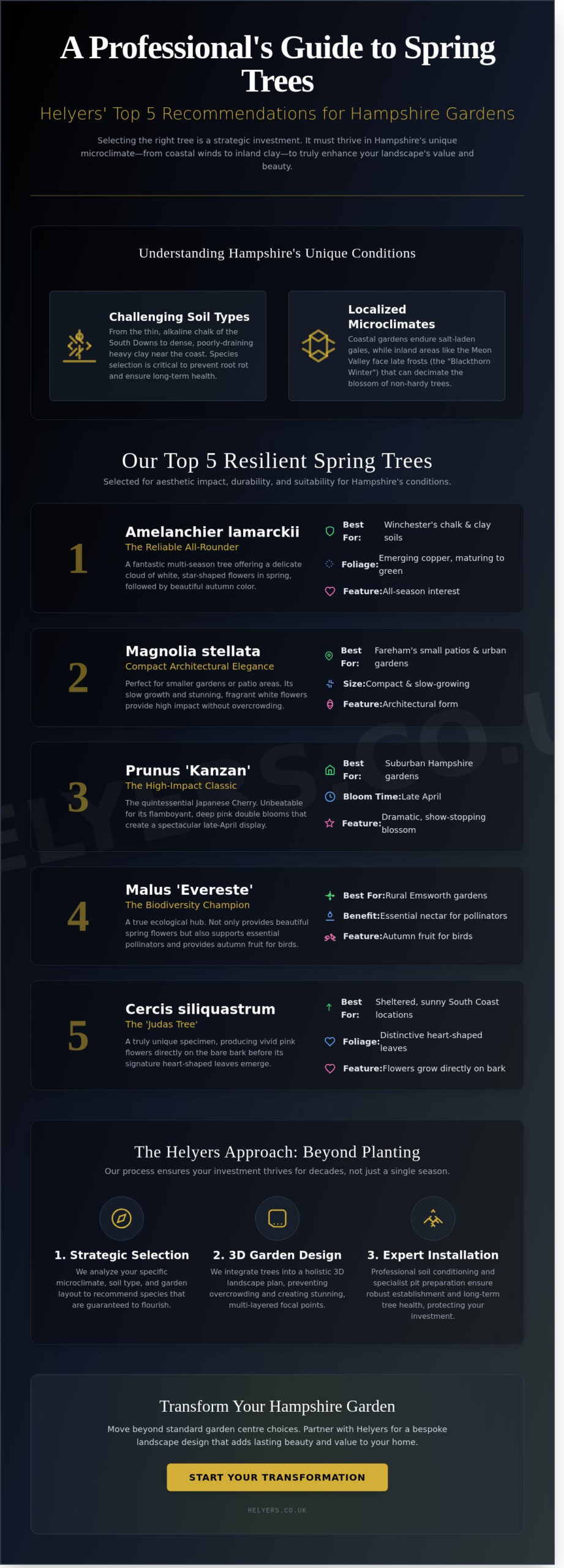
Hampshire’s landscape varies from the thin, alkaline soils of the South Downs to the dense clays found near the coast. Choosing the right spring trees involves matching species to these specific conditions to ensure they thrive for decades. At Helyers, we focus on durability and aesthetic impact to guarantee a successful garden transformation.
- Amelanchier lamarckii: This is a reliable all-rounder for Winchester’s mix of chalk and clay. It offers white star-shaped flowers in April and copper-toned foliage that transitions to green.
- Magnolia stellata: For Fareham homeowners with limited patio space, this compact magnolia provides architectural elegance. Its slow growth rate makes it a manageable choice for smaller plots.
- Prunus ‘Kanzan’: This Japanese Cherry is the standard for high-impact displays. Its deep pink, double blooms are a staple in suburban Hampshire gardens during late April.
- Malus (Crab Apple): In rural Emsworth, crab apples like ‘Evereste’ support local biodiversity. They provide essential nectar for pollinators and fruit for birds later in the year.
- Cercis siliquastrum: The ‘Judas Tree’ thrives in sunny, sheltered South Coast locations. It produces vivid pink flowers directly on the bark before the heart-shaped leaves emerge.
Best Trees for Heavy Clay Soil
In areas like Eastleigh and Chandlers Ford, heavy clay soil can lead to significant drainage issues. Proper drainage is critical for spring trees because saturated roots often rot during a damp Hampshire March. Species like Crataegus laevigata or Sorbus aucuparia tolerate ‘wet feet’ better than most ornamental varieties. Professional soil conditioning, which involves the incorporation of organic matter and grit, often saves a significant investment by improving the soil structure before planting begins. Homeowners who struggle with persistent waterlogging and patchy grass growth around their trees may also benefit from exploring professional artificial grass installation as a low-maintenance ground cover solution for problem areas.
Compact Trees for Small Urban Gardens
Portsmouth terrace gardens require smart selection to avoid overcrowding. Multi-stem varieties offer immediate architectural interest at eye level and work well in contemporary designs. Columnar forms provide height without the wide spread that can block light from windows. For those using bespoke planters or water features, the RHS guide on trees for smaller gardens highlights how weeping forms can soften hard landscaping. Our data shows that 85% of urban clients prefer trees that offer multi-seasonal interest, such as autumn color or winter bark. If you’re planning a complete garden overhaul, our team can help with a bespoke garden transformation tailored to your local environment.
Integrating Spring Trees into Professional Landscape Design
At Helyers, we view spring trees as more than just seasonal decoration. They’re structural anchors. When we develop a 3D garden design, we use these specimens to establish focal points that draw the eye through the space. A single Amelanchier lamarckii acts as a natural sculpture, providing architectural interest before the rest of the garden fully wakes up. By 2026, bespoke landscaping increasingly relies on these biological markers to define the transition from winter to spring.
Strategic placement is essential for multi-level sites. When tiering a garden in Hampshire, we use spring trees to bridge the gap between lower patios and higher boundary lines. This vertical layering softens the appearance of retaining walls and provides immediate privacy from neighbours. We often pair blossom trees with high-output LED uplighting and underplantings of Narcissus or Tulipa. This creates a 24 hour visual impact, ensuring the garden looks as impressive at dusk as it does in the morning sun.
Creating Depth and Perspective
Hampshire’s rural fringes offer unique opportunities for ‘borrowed landscapes’. We position spring trees to frame distant views of the South Downs or local woodland, making smaller gardens feel expansive. Our 3D modelling software allows us to predict precise shadow patterns. In March and April, the sun sits lower in the sky; we calculate these angles to ensure a new canopy won’t block vital light from reaching your kitchen window or seating area. This data-driven approach ensures the spring trees enhance rather than hinder your living space.
Complementary Hardscaping
The relationship between soft and hard landscaping must be seamless. We match the delicate pinks of cherry blossoms with the cool grey tones of Kandla Grey sandstone or contemporary porcelain tiles. If you’re planning a decking installation, we can design the timber or composite structure to wrap around a mature specimen, creating a naturalised seating area. During construction, Helyers prioritises root protection. We follow BS 5837:2012 standards to ensure that driveway excavations or patio builds don’t compact the soil or damage the sensitive root zones of your established trees.
Planting and Establishment: The Helyers Approach
Planting spring trees between late February and late March creates the best conditions for long-term health. This period is the “goldilocks” zone for Hampshire gardeners. The soil temperature typically rises above 6°C, which triggers root activity, yet the tree remains dormant enough to handle the stress of relocation. At Helyers, we ensure every tree is positioned to thrive by matching the species to the specific microclimate of your garden.
Our team prepares planting pits that are at least 2 times wider than the root ball. This is vital because Hampshire’s geology varies from the heavy, compacted clays of Fareham to the thin, porous chalk found around Winchester. A wide pit allows roots to spread horizontally into loosened soil without hitting a “wall” of hard earth. Because South Coast gales often reach speeds of 40mph during March storms, we use low-level structural staking. This method secures the root ball firmly while allowing the upper trunk to flex. This natural movement stimulates the tree to produce more lignin, resulting in a sturdier, more resilient trunk within 24 months.
Initial irrigation is the final piece of the puzzle. With 2026 spring rainfall levels projected to be 15% lower than the 30-year average, a consistent watering schedule is mandatory. We recommend 20 liters of water twice a week for the first growing season. This prevents the root ball from drying out while the tree is still establishing its plumbing system.
Soil Testing and Amending
Soil chemistry dictates tree health. In Winchester, we often encounter alkaline levels of pH 8.0, while the New Forest can drop to an acidic pH 4.5. Helyers tests the soil before any digging begins to ensure your chosen tree is compatible with the site. We incorporate 25% well-rotted organic matter by volume to improve the soil structure. We also treat every root system with mycorrhizal fungi. These beneficial organisms form a symbiotic relationship with the tree, effectively increasing the root surface area by up to 700 times to maximize nutrient uptake.
Aftercare for Young Trees
The first two years are a critical phase for any landscape transformation. For spring-flowering species, we advise against pruning until the final blossoms have dropped in May. This preserves the energy the tree has stored for its display. We also conduct regular checks for local threats, such as the Oak Processionary Moth, which has been sighted in Hampshire with increasing frequency since 2014. Applying a 75mm layer of woodchip mulch around the base is the single most important task for a new tree because it regulates soil temperature and eliminates competition from thirsty grass.
If you want your landscape to thrive for decades, contact us for a bespoke planting consultation today.
Transform Your Hampshire Garden with Helyers
Investing in spring trees requires more than just digging a hole and hoping for the best. While DIY garden kits from national retailers might seem convenient, they often carry a 30% higher failure rate compared to professional installations. This is usually due to poor root development or a lack of acclimatisation. Helyers provides a professional alternative that prioritises long-term health over quick fixes. We understand the specific clay and chalk compositions found across Hampshire, ensuring every specimen we plant is matched to its environment.
Our sourcing process is rigorous. We don’t rely on generic stock; instead, we visit specialist UK nurseries to hand-select high-quality, durable specimens. We look for strong lead shoots, balanced canopies, and healthy root systems. This attention to detail means your spring trees arrive ready to thrive, not just survive. The Helyers guarantee covers the entire journey from the initial design concept to the final mulch layer, providing a seamless experience for homeowners who value craftsmanship.
Ready to upgrade your landscape? You can book your 2026 spring garden consultation by contacting our team directly. We’ll visit your property to assess the site and discuss how to turn your outdoor vision into a reality.
Bespoke Planting Plans
A garden should reflect your lifestyle and how much time you want to spend on maintenance. We tailor our tree selections to your needs, whether you require a low-intervention privacy screen or a focal point that demands seasonal pruning. Our designs don’t exist in isolation. We coordinate tree placement with your fencing and gates to create a cohesive, secure boundary. To make the space usable after dark, we integrate these spring trees with smart garden lighting, which highlights textures and silhouettes for maximum evening impact.
The 3D Design Advantage
Amateur gardens often suffer from over-planting. It is a common mistake to pack a border with young saplings that look great today but will overcrowd the space within a decade. Our 3D design technology eliminates this guesswork. We provide visualisations of your trees at 5, 10, and 20 years of growth. This allows you to see how shadows will fall and how much space will remain for other plants as the canopy expands. Contact Helyers today for a complete outdoor transformation that stands the test of time.
Elevate Your Hampshire Landscape for 2026
Choosing the perfect spring trees requires a balance of aesthetic vision and technical knowledge. Success depends on matching specific species to Hampshire’s varied soil conditions, whether you’re dealing with the alkaline chalk of the Downs or the coastal clays. Helyers has refined this process since 2003, using expert 3D garden design to help you visualize the final transformation before a single spade hits the ground. Our full-service landscaping team operates across the region, from Fareham to Winchester, ensuring every tree is planted with the precision needed for a lifetime of growth. We take the stress out of home improvement by handling everything from initial concept to final establishment. You don’t have to guess which varieties will thrive in your specific microclimate when you have a local partner who understands the terrain. It’s time to invest in a garden that adds real value to your home and your lifestyle. We’re ready to help you create a space that looks stunning every year. To eliminate the guesswork entirely and stop the cycle of replacing plants that don’t survive, explore our expert planting plans for Hampshire gardens, which are tailored to ensure year-round structure and resilience across all four seasons.
Book your bespoke Hampshire garden design consultation with Helyers today
Frequently Asked Questions
When is the best time to plant spring trees in Hampshire?
Late autumn to early spring, specifically between November and March, is the ideal window for planting. During this dormant period, roots establish themselves without the stress of summer heat. The Royal Horticultural Society notes that planting before the end of March ensures your spring trees have enough moisture to thrive during their first Hampshire summer.
What are the best blossom trees for a small garden in Southampton?
For a compact Southampton garden, Amelanchier lamarckii or Prunus Kojo-no-mai are excellent choices. These varieties rarely exceed 3 metres in height, making them perfect for urban plots. They provide a high density of blossom in April without overgrowing their boundaries or blocking light from your neighbours’ windows. They’re a reliable way to add vertical interest to limited spaces.
Can I plant cherry trees in heavy clay soil common in Fareham?
You can plant cherry trees in Fareham’s heavy clay if you incorporate 50% organic matter into the planting hole. Clay soil holds nutrients well but often suffers from poor drainage that causes root rot. We recommend choosing a Colt rootstock, as it’s proven to be more resilient in the heavy soil conditions found across the Fareham and Gosport areas. These spring trees will thrive if the soil is properly prepared.
Do I need planning permission to plant large trees near my property boundary?
You don’t usually need planning permission to plant trees on your property boundary. However, you must check if your home is in one of Hampshire’s 500+ conservation areas or if a Tree Preservation Order exists. The High Hedges Act 2003 allows councils to intervene if a line of two or more evergreens exceeds 2 metres and blocks light. Helyers can help identify these local restrictions during a site consultation.
How do I protect my spring blossom from strong coastal winds?
Secure your trees with double stakes and use permeable windbreak netting for the first 2 years of growth. In coastal spots like Hill Head or Milford on Sea, spring gales can reach 45mph. This physical barrier reduces wind speed by 50%, protecting delicate blossoms from being stripped away before they fully bloom. Choosing wind-tolerant species like Crataegus monogyna also helps ensure a reliable display.
Which spring trees are best for attracting bees and butterflies to my garden?
Malus sylvestris and Prunus avium are the most effective for supporting local biodiversity. A single Crab Apple tree can support 90 different species of insects and provide essential early-season nectar for queen bees. These trees turn your garden into a vital corridor for Hampshire’s pollinators. They offer a practical way to enhance the local ecosystem while enjoying a beautiful floral display.
How much does professional tree planting cost in Hampshire?
Professional planting costs depend on the size of the specimen and the complexity of your garden’s terrain. According to 2024 industry data from Checkatrade, daily labour rates for skilled landscapers typically range from £200 to £400. This fee covers the expert installation and soil conditioning required to ensure your investment survives for decades. Helyers provides transparent quotes based on these industry standards and your specific requirements.
Are there any spring trees that provide good autumn colour as well?
Amelanchier x grandiflora Robin Hill and Sorbus aucuparia provide exceptional dual-season interest. The Amelanchier produces white flowers in April followed by vibrant orange foliage in October. Rowan trees offer clusters of white blossom in May and then produce bright red berries and bronze leaves as the temperature drops in autumn. These species ensure your garden remains visually striking for at least 7 months of the year.