


Last February, when Storm Eunice brought record-breaking 122mph gusts to the South Coast, thousands of Hampshire homeowners woke up to find their garden boundaries flattened. It’s a frustratingly common sight across the county, especially where cheap lap panels struggle against the combination of high winds and damp, heavy clay soil. You likely already know that a standard fence isn’t just an aesthetic choice. It’s a vital line of defence for your home’s security and your family’s privacy, yet many off-the-shelf solutions fail within just a few seasons.
At Helyers, we believe your garden deserves better than a temporary fix that rots or rattles in the breeze. This is why closeboard fencing remains the gold standard for local properties seeking a permanent solution. In this guide, we’ll explain how this robust, bespoke construction provides a long-lasting barrier that withstands the unpredictable Hampshire weather while adding genuine value to your home. You’ll discover the technical benefits of our professional craftsmanship and why investing in a sturdy, hand-built boundary avoids the common DIY pitfalls that lead to leaning posts and compromised privacy.
Key Takeaways
- Understand why closeboard fencing is the preferred choice for Hampshire homeowners seeking superior strength and privacy compared to standard panels.
- Learn how the robust construction of vertical feather edge boards offers double the lifespan of cheaper alternatives, protecting your investment for years to come.
- Explore bespoke design options, from decorative trellis toppers to contemporary colour finishes, that transform a simple boundary into a stylish garden feature.
- Discover the essential installation techniques required to withstand Hampshire’s heavy clay soils and coastal salt air in areas like Portsmouth and Southampton.
- Find out how Helyers of Hampshire applies over 20 years of local craftsmanship to ensure every installation is a high-end, durable transformation for your property.
What is Closeboard Fencing and Why is it the Hampshire Favourite?
Closeboard fencing serves as the reliable backbone for residential gardens across Fareham, Winchester, and Portsmouth. This style is constructed using vertical feather edge boards that overlap, supported by heavy-duty horizontal rails. It’s often called the workhorse of the fencing world because it combines a tidy, professional aesthetic with the structural integrity required to face South Coast weather. In exposed areas near the Solent, homeowners need boundaries that don’t just look good but stay standing during seasonal gales.
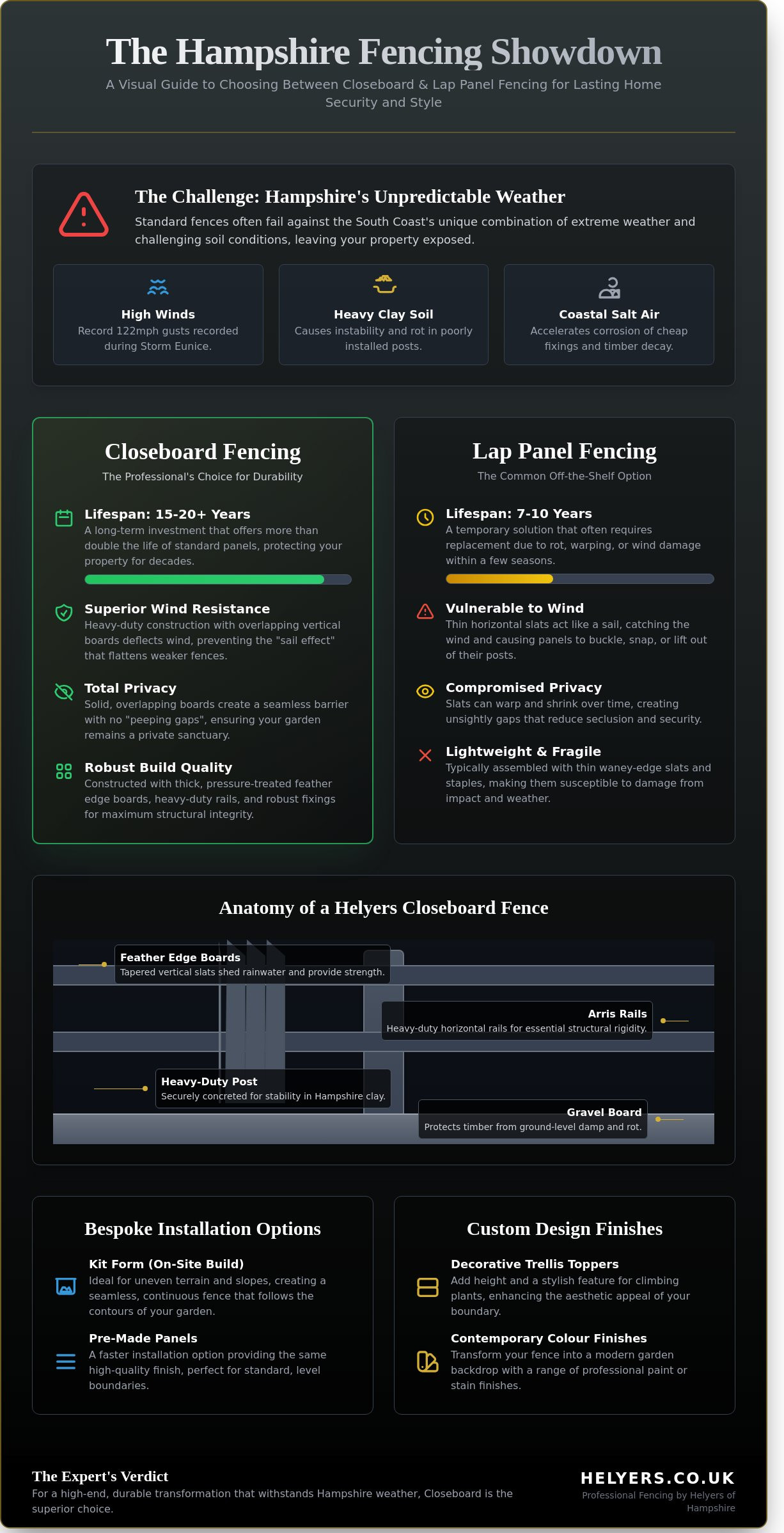
The primary benefits of Close boarded fencing include superior privacy and exceptional wind resistance. Unlike “waney edge” or “lap” panels, which use thinner horizontal slats held together by staples, closeboard fencing utilizes thicker timber and robust fixings. A well-installed closeboard boundary can last 10 to 15 years longer than cheaper lap alternatives. The vertical orientation of the boards allows wind to deflect more efficiently, reducing the “sail effect” that often causes lighter panels to buckle or snap during storms.
The Anatomy of a Quality Closeboard Fence
At Helyers, we believe the secret to a durable fence lies in its components. Feather edge boards are the visible stars; these are tapered vertical slats designed to shed rainwater quickly. These boards are nailed to horizontal arris rails, which provide the essential structural rigidity. We always recommend including gravel boards at the base. These sacrificial timber or concrete barriers prevent the vertical boards from touching the damp Hampshire soil. This simple addition prevents ground-level rot and significantly extends the lifespan of the entire installation.
Traditional Kit Form vs. Closeboard Panels
Homeowners can choose between two main installation methods depending on their property layout. Kit form fencing is built piece-by-piece on-site. This bespoke approach is ideal for the uneven terrain often found in the Meon Valley or older Winchester gardens, as it allows the fence to follow the natural contours of the land without leaving gaps. It creates a seamless, continuous run of timber that looks uniform from every angle.
Alternatively, pre-made closeboard panels offer a faster installation for standard, level boundaries in modern Fareham housing developments. These panels provide the same look and privacy but are manufactured in set sizes, usually 6ft wide. While panels are convenient for quick replacements, the kit form remains the gold standard for a professional transformation on complex property lines. Both options ensure your garden remains a private sanctuary, providing a secure perimeter that adds tangible value to your home.
Closeboard vs. Lap Panels: The Ultimate Performance Comparison
Choosing between different fencing styles often comes down to the balance between immediate cost and long-term resilience. While lap panels are a common sight in many DIY stores, closeboard fencing offers a level of structural integrity that budget alternatives cannot match. A well-constructed closeboard fence typically lasts 15 to 20 years, whereas standard lap panels often require replacement after just 7 to 10 years due to rot or wind damage. This longevity is rooted in the natural durability of timber and the way individual featheredge boards are assembled to allow for natural movement without compromising the frame.
Privacy is a primary concern for Hampshire homeowners. Lap panels use thin horizontal slats that can warp over time, creating “peeping” gaps that compromise your garden’s seclusion. In contrast, closeboard utilises overlapping vertical boards that maintain a solid, opaque barrier. This construction also makes it the superior choice for the South Coast’s gusty weather. During winter storms where wind speeds in coastal areas like Fareham can exceed 60mph, the reinforced structure of closeboard, supported by heavy-duty posts and rails, stands firm while lighter panels often buckle or lift out of their channels. Beyond the functional benefits, the vertical lines of closeboard provide a premium, clean backdrop that complements both traditional and contemporary Hampshire garden designs.
Cost-Effectiveness Over Time
Homeowners in Fareham are increasingly moving away from budget panels to avoid the cycle of storm damage repairs. While the initial investment for closeboard fencing is higher, the true cost is significantly lower when you factor in replacement frequency. A lap fence may need replacing twice in the time one closeboard installation remains standing. Maintenance is straightforward; applying a high-quality preservative every 3 to 5 years protects the wood from moisture and UV damage, ensuring the timber retains its structural strength.
Security and Boundary Protection
A solid boundary acts as a powerful deterrent. Closeboard is notoriously difficult to breach because the boards are nailed individually to a sturdy frame, unlike lap panels which can be easily kicked through or lifted from their posts. For residential properties, the standard height of 1.8 metres provides excellent security without requiring planning permission, though we can advise on the legal 2-metre limit for specific boundary conditions. Integrating a bespoke, heavy-duty gate creates a seamless and secure perimeter that protects your property. If you are planning a garden overhaul, you can view our recent fencing projects to see how these installations look in local settings.
Designing Your Boundary: Customising Closeboard for Modern Gardens
Standard closeboard fencing provides a robust perimeter, but modern garden design often requires a more tailored approach. Homeowners across Hampshire are increasingly moving away from the basic utility look. They’re opting for bespoke configurations that integrate seamlessly with their wider landscaping. When you choose high-quality timber, you aren’t just buying a barrier; you’re investing in a versatile design tool that can be adapted to suit any architectural style, from traditional Winchester cottages to contemporary Fareham developments.
Trellis Toppers and Decorative Finishes
Adding a 300mm or 600mm trellis topper instantly softens the boundary. Square trellis offers a minimalist, contemporary feel, while diamond patterns suit more classic garden aesthetics. These additions provide essential support for climbing species like Clematis or Honeysuckle without blocking the breeze. To ensure a professional finish that lasts its expected 15-year service life, Helyers adheres to the high standards promoted by the Association of Fencing Industries (AFI). This ensures every decorative element remains as sturdy as the main structure. Post caps and finials serve a dual purpose; they protect the end grain of the timber from moisture while adding a refined architectural detail that mirrors the character of your home.
Timber doesn’t have to stay the standard pressure-treated brown. Contemporary palettes now include slate grey, olive green, and even deep charcoal tones. These modern finishes provide a sophisticated contrast against the vibrant greens of a Hampshire garden. Using a high-quality UV-resistant stain ensures the colour remains consistent even on south-facing boundaries that receive direct sunlight for 10 hours a day during the summer months.
Fencing as a Backdrop for Planting
The vertical lines of closeboard fencing create a rhythmic, structured backdrop that highlights the varied textures of garden flora. If your garden sits on the heavy clay common in parts of the South Coast, the choice of timber shade is vital for the visual health of your space. Light oak finishes reflect sunlight into shaded corners, while darker tones make bright blooms stand out with dramatic intensity. For specific advice on what will thrive in your local environment, see our expert planting plans for Hampshire’s clay soil.
Think of your fencing as a 3D structural element rather than a flat surface. It shouldn’t just sit at the edge of the property. We often use closeboard fencing to create internal zones, such as screening a utility area or framing a new porcelain patio. By aligning the height of the fence with the level of your decking or garden walls, you create a seamless transition. This methodical approach makes the garden feel like a cohesive outdoor room, increasing the perceived value and usability of your property.
Hampshire Installation Guide: Soil, Wind, and Local Factors
Installing closeboard fencing in Hampshire requires more than just a hammer and nails. The local geography presents specific challenges that can undermine a poorly built structure. Much of the county, particularly around Fareham and Eastleigh, sits on heavy Hampshire clay. This soil expands when wet and shrinks during dry summers. Without footings dug to a minimum depth of 600mm and backfilled with a high-quality concrete mix, your fence will lean within two seasons. Helyers ensures every post is anchored deep enough to withstand these constant ground shifts.
Coastal locations like Portsmouth and Southampton face the additional threat of salt-laden air. This environment accelerates timber decay and can corrode standard fixings. We use galvanised nails and premium treated timber to prevent the “salt-rot” that often claims inferior fences. On the South Downs, slopes are the primary hurdle. Closeboard fencing is the superior choice here because we can rake the fence. This follows the natural contour of the land rather than leaving awkward triangular gaps at the bottom, which is a common flaw with pre-made panels. A Helyers installation is a long-term investment. We build every structure to withstand the unpredictable UK climate, ensuring your fence remains upright even if a 2026 gale hits the coast.
Ground Conditions and Post Selection
In damp regions like the Meon Valley, choosing the right post is vital. Concrete posts offer the longest lifespan in waterlogged soil, but many homeowners prefer the natural aesthetic of wood. We provide several options to ensure longevity:
- UC4 Pressure-Treated Timber: This is non-negotiable for any timber in permanent ground contact to prevent premature rot.
- Concrete Gravel Boards: These keep the fence vertical components off the damp earth.
- Weathered Footings: We slope the concrete at the post base to shed water away from the wood.
These technical choices prevent the standing puddles that cause base-rot in inferior installations. Our teams assess your specific garden drainage before a single hole is dug.
Planning and Neighbourhood Etiquette
Hampshire contains 31 conservation areas in the New Forest alone, and many others in Winchester and Romsey. Under the General Permitted Development Order 2015, fences over 2 metres usually require planning permission. If your garden borders a highway, this limit drops to 1 metre. Helyers helps you navigate these local regulations to ensure your project stays compliant with local authority rules. We also prioritise neighbourly relations. Our teams work strictly within your boundary lines and maintain a tidy site, ensuring the transformation of your garden doesn’t cause friction next door.
Ensure your garden is prepared for the next big storm by choosing a professional installation. Contact Helyers for a durable fencing quote today.
Why Helyers of Hampshire is the Expert Choice for Fencing
Helyers brings more than 20 years of craftsmanship experience to every project across Fareham and the South Coast. We’ve spent two decades refining our techniques to ensure that your garden remains secure and stylish for years. We don’t offer generic DIY kits that degrade after a few seasons. Every installation is a high-end transformation designed to add value to your property and provide long-term peace of mind.
Our commitment to quality starts with our materials. We only use durable, sustainably sourced timber. This ensures your closeboard fencing is resistant to the unpredictable British weather while supporting responsible forestry practices. For clients looking for a complete outdoor overhaul, we integrate our fencing services with advanced 3D garden design. This allows you to see how your new boundaries will look alongside patios, lawns, and planting schemes before the first post is even driven into the ground.
Our Professional Installation Process
Our workflow is methodical and transparent. It begins with a comprehensive site survey where we measure every centimetre and check for underground utilities. We believe that a ‘built-on-site’ approach is far superior to using pre-fabricated panels. By constructing the fence piece-by-piece, we can follow the natural curves and slopes of your land. Our professional installation includes:
- Detailed ground assessment and soil condition checks
- Precision post-setting using high-grade concrete for maximum stability
- Hand-nailing individual pales to ensure a bespoke, gap-free fit
- A thorough site clean-up and final handover
In March 2024, we transformed a property in Winchester that featured a challenging 40-metre boundary on a significant incline. While standard panels would have left large gaps at the base, our team hand-built the closeboard fencing to sit flush with the ground. This provided the homeowner with maximum privacy and a professional finish that standard contractors simply can’t match.
Start Your Garden Transformation
Securing your home shouldn’t be a stressful process. We provide a clear, low-pressure path to starting your project. Whether you need a small repair or a total boundary redesign, our experts are here to help. You can read our complete guide to garden fencing & gates in Hampshire to learn more about the different styles we offer.
When you’re ready to proceed, get in touch for a bespoke consultation. We’ll discuss your specific requirements and provide a detailed plan for your outdoor space. Contact Helyers of Hampshire for a professional fencing quote and take the first step toward a more beautiful, durable garden today.
Secure Your Garden’s Future with Expert Craftsmanship
Choosing the right boundary is a vital step in protecting and enhancing your property. You’ve seen why closeboard fencing remains the superior choice for Hampshire gardens, offering a level of durability and wind resistance that standard lap panels simply can’t match. By selecting a bespoke installation, you’re investing in a structure that’s built to last, tailored to the specific soil and weather conditions of the South Coast.
Helyers of Hampshire has delivered high-quality outdoor transformations since 2003. We’re specialists in 3D garden design and have served homeowners across Fareham, Southampton, and Winchester for over 20 years. Our team understands that a fence isn’t just a barrier; it’s the frame for your entire outdoor living space. We combine technical expertise with a commitment to quality that ensures your investment adds genuine value to your home.
Ready to upgrade your garden with a professional finish? Book your bespoke fencing consultation with Helyers of Hampshire. We’re here to help you build a garden that stands the test of time.
Frequently Asked Questions
How long does closeboard fencing typically last in Hampshire?
A professionally installed closeboard fence typically lasts between 15 and 20 years in the Hampshire climate. The lifespan depends on the quality of the timber and the level of exposure to local coastal winds. Helyers uses pressure-treated timber to ensure your closeboard fencing resists rot and insect damage. Regular maintenance can extend this lifespan by a further 5 years.
Do I need planning permission for a 6ft closeboard fence in Fareham?
You don’t usually need planning permission for a 6ft (1.83m) fence in Fareham because it falls under permitted development rules for heights up to 2 metres. However, if the fence borders a highway used by vehicles, the legal limit is 1 metre. It’s vital to check with Fareham Borough Council if your property is a listed building or sits within a conservation area.
Is it better to use concrete or wooden posts for my new fence?
Concrete posts are the superior choice for longevity because they don’t rot in the ground and provide a 25-year structural lifespan. Wooden posts offer a more seamless, bespoke aesthetic for your garden but require more frequent checks for ground-level decay. At Helyers, we find that 80% of local homeowners choose concrete for its maintenance-free durability.
Can closeboard fencing be installed on a sloping garden?
Closeboard fencing is the ideal solution for sloping gardens because it’s constructed on-site rather than using pre-made panels. This allows our team to “rake” the fence, which means following the natural contour of your land without leaving gaps at the bottom. This bespoke approach ensures a secure boundary regardless of the gradient in your Hampshire garden.
How often should I treat my closeboard fence to prevent rot?
You should apply a high-quality wood preservative to your closeboard fence every 2 to 3 years. While the timber is pressure-treated during manufacturing, a regular top-up treatment maintains the water-repellent barrier. This simple maintenance task prevents the 100mm feather edge boards from warping or splitting during dry Hampshire summers.
What is the difference between feather edge and closeboard fencing?
There’s no functional difference between the two terms; feather edge refers to the individual tapered boards while closeboard fencing describes the complete system. The system consists of vertical feather edge boards overlapped and nailed to horizontal arris rails. This construction creates a heavy-duty, solid barrier that offers better wind resistance than standard lap panels.
Can you install closeboard fencing in a garden with heavy clay soil?
We can certainly install fencing in heavy clay soil, which is common across many parts of Hampshire. Our team digs post holes to a minimum depth of 600mm and uses a specific mix of Postcrete to ensure stability. This method prevents the “heave” often associated with clay soils during wet winter months, ensuring your posts remain upright.
How much does professional fencing installation cost in Southampton?
Professional fencing installation in the Southampton area typically costs between £70 and £120 per linear metre including materials and labour. According to 2024 industry data from Checkatrade, a standard 36-foot run of fencing averages between £1,000 and £1,500. Prices vary based on your choice of posts and the complexity of removing your old garden structures.