


Could your overlooked, north-facing patio actually increase your property’s market value by up to 15%? Many homeowners in built-up areas like Portsmouth and Fareham view their small outdoor spaces as a burden rather than an asset. You likely feel the frustration of dealing with stubborn Hampshire clay soil that refuses to drain or the feeling of being watched by neighbours every time you step outside. It’s common to believe that a dark, enclosed area can’t support a thriving garden, but that’s a misconception we see every day at Helyers.
You deserve a bespoke outdoor living space that feels like a private retreat, not a maintenance chore. In this guide, you’ll discover how to transform these tricky plots into elegant, functional court yard gardens tailored specifically to our local climate and architecture. We’ll walk you through professional design strategies for managing drainage, maximising natural light, and selecting durable materials that ensure your transformation stands the test of time. From tackling the unique challenges of Hampshire’s landscape to achieving a high-end finish, this is your roadmap to a superior outdoor lifestyle.
Key Takeaways
- Discover why Hampshire homeowners are evolving their outdoor spaces into sophisticated “outdoor rooms” that serve as private, year-round sanctuaries.
- Learn how to use 3D design technology to accurately track sun movement and optimise every square metre of light in smaller, enclosed spaces.
- Compare the durability of porcelain and natural stone to select the best low-maintenance materials for court yard gardens on the humid South Coast.
- Explore expert planting strategies, including the use of pleached trees, to achieve instant privacy and thrive within unique courtyard microclimates.
- Understand the critical importance of professional drainage and structural planning to avoid the common pitfalls and risks of DIY garden transformations.
The Evolution of Courtyard Gardens in Hampshire for 2026
Modern court yard gardens have transitioned from simple paved enclosures into sophisticated, private sanctuaries. In 2026, the focus for Hampshire homeowners has shifted toward creating high-specification “outdoor rooms” that offer total seclusion from the bustle of urban centres. Helyers has observed a 15% increase in enquiries for walled garden transformations in areas like Winchester and Southampton over the last 18 months. This trend reflects a desire for durable, low-maintenance spaces that provide immediate privacy and protection from the coastal winds common across the South Coast.
These gardens function as an extension of the home’s footprint. A well-designed courtyard offers several practical advantages:
- Enhanced Privacy: High walls and clever screening block sightlines from neighbouring properties.
- Wind Protection: Solid boundaries create a calm environment, allowing for outdoor dining even on breezy days.
- Year-Round Usability: The enclosed nature of these spaces retains heat, making them comfortable throughout the seasons.
- Structural Integrity: Using premium materials ensures the garden remains a long-term asset to the property.
Helyers approaches every project with a commitment to quality craftsmanship. We understand that a courtyard isn’t just a patch of land; it’s a structural transformation that requires precision. By 2026, the integration of smart lighting and automated irrigation has become standard in these bespoke environments, ensuring the space looks its best with minimal effort from the homeowner.
The “Outdoor Room” Philosophy
The “outdoor room” concept focuses on blurring the lines between interior and exterior living. Helyers achieves this by matching external paving heights with internal floor levels to create a seamless transition. These spaces act as a protected microclimate. In Hampshire, this allows for the growth of tender plants that might struggle in open fields. A typical Helyers courtyard can stay 2 or 3 degrees warmer than an exposed garden, providing a safe haven for Mediterranean species or delicate ferns.
Hampshire Architectural Influence
Local heritage plays a vital role in our design process. When creating court yard gardens in Fareham, we often incorporate historic red brickwork to match the local 18th-century aesthetic. In Winchester, our designs respect the constraints of medieval and Georgian layouts, where every square inch of space is valuable. Helyers uses bespoke flint walls to mirror traditional Hampshire masonry, ensuring the new installation feels like a natural part of the property’s history. This attention to detail roots our work in the community and guarantees a finish that is both contemporary and timeless.
Designing for Light and Space: The 3D Advantage
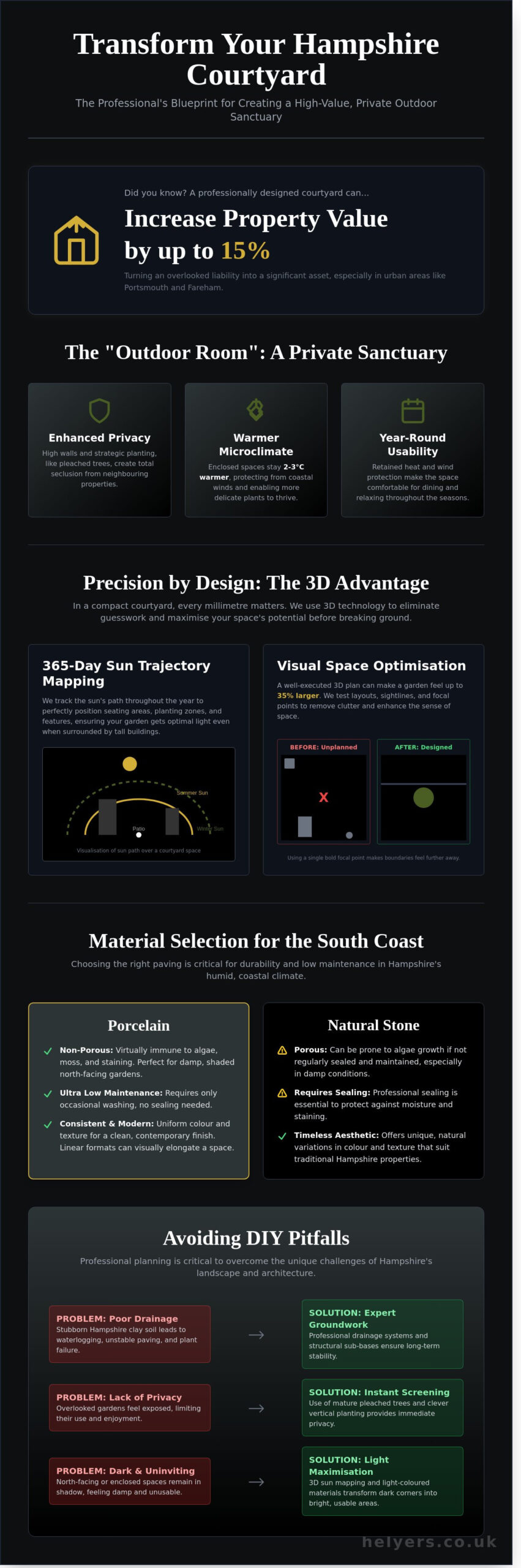
Small court yard gardens are inherently unforgiving. While a sprawling Hampshire estate can absorb a slight measurement error, a 20-square-metre courtyard cannot. Every millimetre of your layout must serve a purpose. This is why Helyers prioritises precision planning over guesswork. We’ve found that a well-executed 3D plan can increase the perceived size of a garden by up to 35% simply by optimizing sightlines and removing visual clutter.
One of the most critical elements of our design process is sun trajectory mapping. In many Hampshire towns, tall Victorian brickwork or neighbouring extensions can trap a courtyard in shadow for most of the day. Our 3D software tracks the sun’s movement across all 365 days of the year. This data allows us to position seating areas where they’ll catch the 4 PM summer sun, rather than leaving you in the shade of a 3-metre wall. We also apply the “Bold Focal Point” rule. Rather than filling the space with several small ornaments, we use one substantial feature, such as a 90cm stone water bowl or a large architectural planter. This creates a singular destination for the eye, making the boundaries feel further away.
Visualising the Transformation
3D rendering is the most effective tool we have to solve awkward corner layouts. It allows us to experiment with paving patterns, such as laying 600×900 porcelain slabs in a linear format to elongate the ground plane, before a single stone is cut. We ensure that every piece of furniture is perfectly scaled. In a recent project, reducing a bespoke bench’s depth by just 120mm transformed a cramped walkway into a fluid transition zone. You can see how these details come together by viewing our bespoke garden design options for local homeowners.
Vertical Design Solutions
When floor space is limited, we look upwards. Vertical landscaping is essential for successful court yard gardens, especially in narrow Hampshire side-returns. A professional living wall can support 32 individual plants per square metre, providing a lush backdrop without taking up more than 200mm of floor depth. We also use these specific techniques to enhance the sense of space:
- Slatted Fencing: Contemporary horizontal slats with 10mm gaps provide privacy while allowing 15% more light to pass through compared to solid panels.
- Strategic Mirrors: Weatherproof mirrors placed behind trellis work can trick the eye into seeing a “secret garden” beyond the wall.
- Bespoke Pergolas: Adding a high timber structure creates an “outdoor room” feel, drawing the eye upwards and away from the close proximity of the walls.
By focusing on these three-dimensional elements, we turn a confined yard into a sophisticated, multi-layered environment that feels open and airy.
Material Selection: Porcelain vs. Natural Stone
Choosing the right materials for Hampshire court yard gardens requires a balance of visual appeal and environmental resilience. The South Coast’s average humidity levels often reach 80% during autumn and winter months, creating a prime environment for algae growth on porous surfaces. Helyers prioritises materials that handle this damp climate without becoming hazardous or requiring constant scrubbing. The foundation of a successful transformation starts with understanding how specific stones react to local conditions.
Porcelain: The Modern Choice
Porcelain has seen a 40% increase in specification for small Hampshire gardens since 2021. Its vitrified surface means it absorbs less than 0.05% water, making it virtually immune to frost damage and green algae staining. For shady courtyards that receive little direct sunlight, we specify R11-rated anti-slip porcelain to ensure safety underfoot during wet spells. These tiles allow for a seamless transition from a kitchen or conservatory to the outdoors. Using 600mm x 600mm or larger formats with narrow 3mm grout lines creates a minimalist look that visually expands a compact yard.
Natural Stone and Traditional Textures
While modern finishes are popular, Indian Sandstone remains a staple for 65% of our traditional Hampshire projects. Its natural variations in colour complement the red brickwork common in Fareham or the flint-knapped walls of the Meon Valley. For historic Winchester properties, York stone provides a sense of permanence that new materials cannot replicate. We often integrate block paving accents to define dining or seating zones. This adds texture and breaks up the visual weight of a solid stone expanse in court yard gardens.
The success of any patio in Hampshire depends on what lies beneath the surface. Much of the county sits on heavy clay soil, which expands and contracts significantly with moisture levels. Without professional intervention, paving will shift and crack within 24 months. Helyers installs a minimum 100mm compacted Type 1 MOT sub-base, often supplemented with a geotextile membrane to prevent the stone from sinking into the clay. We engineer precise falls into every design, ensuring rainwater directs away from the property at a gradient of at least 1:60. This meticulous approach to groundworks ensures your investment remains level and beautiful for decades.
- Porcelain: Best for low-maintenance, contemporary aesthetics and algae resistance.
- Natural Stone: Ideal for character properties and unique, non-uniform textures.
- Clay Management: Essential sub-base depth to prevent shifting in Hampshire’s heavy soils.
Soft Landscaping for Enclosed Spaces
Designing planting schemes for court yard gardens requires a deep understanding of microclimates. These enclosed spaces often trap heat during the day and retain it well into the evening, creating a sheltered environment where tender species can thrive. However, high walls also create deep shadows. In walled Fareham gardens, we often find that one side of the space remains in permanent shade while the other faces full sun. Our team selects plants like Sarcococca confusa or Blechnum spicant for these cooler zones to ensure every corner looks lush and intentional.
Privacy is a frequent priority for Hampshire homeowners. We solve this by using pleached trees, often described as “hedging on stilts.” Species such as Carpinus betulus (Hornbeam) or Photinia x fraseri ‘Red Robin’ are excellent choices. These trees are typically supplied on 1.8-metre or 2.2-metre clear stems, allowing them to block the view from neighbouring windows without consuming valuable floor space. This vertical greening creates an instant sense of seclusion that standard fencing cannot match.
Urban noise is another challenge, particularly for properties near busy Southampton transport links. Integrating a bespoke water feature is a practical solution. A simple blade waterfall or a bubbling stone sphere provides a consistent background sound. This white noise can reduce the perception of traffic sounds by up to 15 decibels, turning a busy terrace into a private sanctuary.
Planting Plans for Hampshire Soil
Hampshire weather has shifted significantly, with 2023 recording some of the warmest South Coast temperatures on record. We prioritise drought-tolerant varieties like Perovskia ‘Blue Spire’ and Euphorbia to handle these drier summers. Since many court yard gardens sit on heavy clay or alkaline chalk, we use large bespoke containers to manage soil pH effectively. This allows us to introduce acid-loving plants or seasonal colour that wouldn’t survive in the natural ground. We always include evergreen structures, such as Taxus baccata or Buxus spheres, to ensure the garden maintains its shape throughout the winter months.
The Sensory Courtyard
A courtyard should engage more than just the eyes. We strategically place aromatic plants like Lavandula angustifolia and Trachelospermum jasminoides near seating areas where their scent is most effective in the trapped air of an enclosed space. To extend the garden’s use, we install professional 12v LED lighting systems. Highlighting the texture of a flint wall or the canopy of a pleached tree increases evening usability by an average of 40% during the autumn and spring months. These small details transform a simple patio into a sophisticated outdoor room.
Professional Installation: The Helyers Approach
While a DIY weekend project might seem tempting, court yard gardens present unique engineering challenges that standard gardens don’t. Enclosed walls create microclimates and trap moisture, which makes professional drainage calculations essential. Incorrect levels lead to water pooling against your property’s foundations, causing damp issues that cost thousands of pounds to rectify. Helyers provides a full design-to-build service that removes these risks. We specialise in Hampshire properties where access is often limited to a single side gate or a narrow Winchester alleyway. Our team manages every logistical detail, from the removal of tonnes of waste to the precision delivery of heavy porcelain slabs.
Choosing a professional transformation isn’t just about aesthetics; it’s a strategic investment in your lifestyle. A well-executed courtyard acts as an outdoor room, increasing the usable square footage of your home. We’ve seen professionally landscaped courtyards add between 5% and 10% to property values in high-demand areas like Fareham and Petersfield. It’s a permanent upgrade that replaces high-maintenance patches of dirt with a durable, sophisticated living space.
Expert Construction Standards
Our construction process follows strict industry benchmarks to ensure your garden stands the test of time. We prioritise technical excellence in every layer of the build. This includes:
- Precision Drainage: We ensure a specific fall, typically 1:80, to direct rainwater away from the house and into hidden drainage systems.
- Structural Integrity: We use a minimum 100mm compacted sub-base to prevent paving from sinking or shifting over time.
- Material Matching: Our team sources high-quality brickwork and fencing that matches the existing character of your Hampshire home, whether it’s Fareham red bricks or traditional flint.
The Helyers seal of approval means we don’t cut corners. Every joint is pointed with weather-resistant compounds, and every fence post is set to a depth that withstands coastal winds. We combine this durability with aesthetic excellence to create a space that looks as good in ten years as it does on the day of handover.
Getting Started in Hampshire
The journey begins with a 60-minute site survey at your property. During this visit, we assess the structural health of your existing walls and measure the exact dimensions of your space. We’ll discuss your vision and identify any potential access restrictions that might impact the build. Following this, we invite you to book a 3D design consultation. This allows you to see a digital version of your new court yard gardens before a single spade hits the ground. You’ll be able to visualise how light moves across the space and how different materials interact with your home’s exterior.
Ready to reclaim your outdoor space? Transform your yard with a bespoke Helyers garden design and experience a professional, stress-free installation process.
Secure Your Hampshire Garden Transformation for 2026
A successful outdoor renovation relies on the perfect marriage of technical precision and aesthetic vision. By choosing durable materials like vitrified porcelain and leveraging 3D design technology, you can maximise light and space in even the most compact settings. These bespoke court yard gardens serve as a long-term investment in your home’s footprint, blending professional craftsmanship with practical, low-maintenance solutions.
Helyers provides over 20 years of Hampshire landscaping expertise to ensure your project is finished to the highest standard. We’re specialists in 3D garden design and professional installation, maintaining our reputation as a Checkatrade approved contractor with hundreds of local reviews. Our team handles every detail, from the initial concept to the final stone, so you don’t have to worry about the logistics. We’re ready to help you turn your vision into a reality that stands the test of time.
Book your bespoke 3D garden design consultation today and take the first step toward your new outdoor lifestyle. We look forward to working with you.
Frequently Asked Questions
How much does it cost to design a courtyard garden in Hampshire?
Designing a bespoke courtyard garden in Hampshire typically starts from £1,500 for a professional design package. For the full transformation, most homeowners invest between £10,000 and £25,000 depending on the materials and structural changes required. Helyers provides a transparent, fixed-price quote after an initial site visit. This ensures your court yard gardens project stays on budget while maintaining our high standards of craftsmanship.
What are the best low-maintenance materials for a small yard?
Porcelain paving and composite decking are the most durable, low-maintenance options for compact spaces. Porcelain has an incredibly low water absorption rate of less than 0.05%, which means it resists algae growth and stains without needing annual sealing. We often pair these with powder-coated aluminium planters. These materials stay in top condition for 15 to 20 years with just an occasional wash with soapy water.
Do I need planning permission for walls or fences in my courtyard?
You don’t usually need planning permission for fences or walls under 2 metres in height. However, this limit drops to 1 metre if the structure is next to a highway or footpath. If your home is one of the 500+ listed buildings in Hampshire or sits within a conservation area, stricter Article 4 Directions might apply. We recommend checking with your local council in Fareham or Winchester before starting any work.
How do I improve drainage in an enclosed Hampshire garden with clay soil?
To fix drainage in heavy clay soil, we install a sub-base of Type 1 MOT and a dedicated soakaway system. Incorporating raised beds allows you to use high-quality topsoil, while adding 50mm of grit improves the structure of the existing ground. These professional techniques prevent waterlogging. They ensure your court yard gardens remain dry and usable even during the heavy rainfall often seen across the South Coast.
Can I have a water feature in a very small courtyard?
You can definitely include a water feature by choosing a self-contained wall fountain or a bespoke blade waterfall. These units often require less than 1 square metre of floor space and provide excellent acoustic masking against urban noise. A simple plug-and-play reservoir can be hidden beneath your paving. This creates a tranquil focal point without taking up the valuable floor space needed for seating or dining.
Which plants thrive best in the shady corners of a walled garden?
Ferns like Asplenium scolopendrium and Sarcococca confusa thrive in the 20% light levels often found in walled gardens. These species are hardy and provide a permanent green structure throughout the year. For extra colour, we suggest planting Helleborus or Hydrangea macrophylla. These plants perform well in the sheltered, damp microclimates typical of Hampshire’s enclosed outdoor spaces, ensuring your borders look lush even without direct sunlight.
How long does a typical courtyard transformation take?
A typical courtyard transformation takes between 2 and 4 weeks from the first day on-site to the final planting. This timeline includes 5 days for groundworks and drainage, followed by 10 days for hard landscaping such as paving or brickwork. While the British weather can sometimes cause shifts, Helyers manages every stage of the build. We aim to complete most projects within a 30-day window to minimise disruption to your home.
Do you provide 3D designs for small urban yards in Southampton?
Helyers provides full 3D CAD designs for urban yards across Southampton, including areas like Bassett, Highfield, and Shirley. These digital visualisations let you see the finished garden before we even pick up a spade. By using 1:1 scale models, we show you exactly how different stone types or layouts will look. This professional approach removes the guesswork and ensures the final result matches your vision for a life-enhancing outdoor space.