


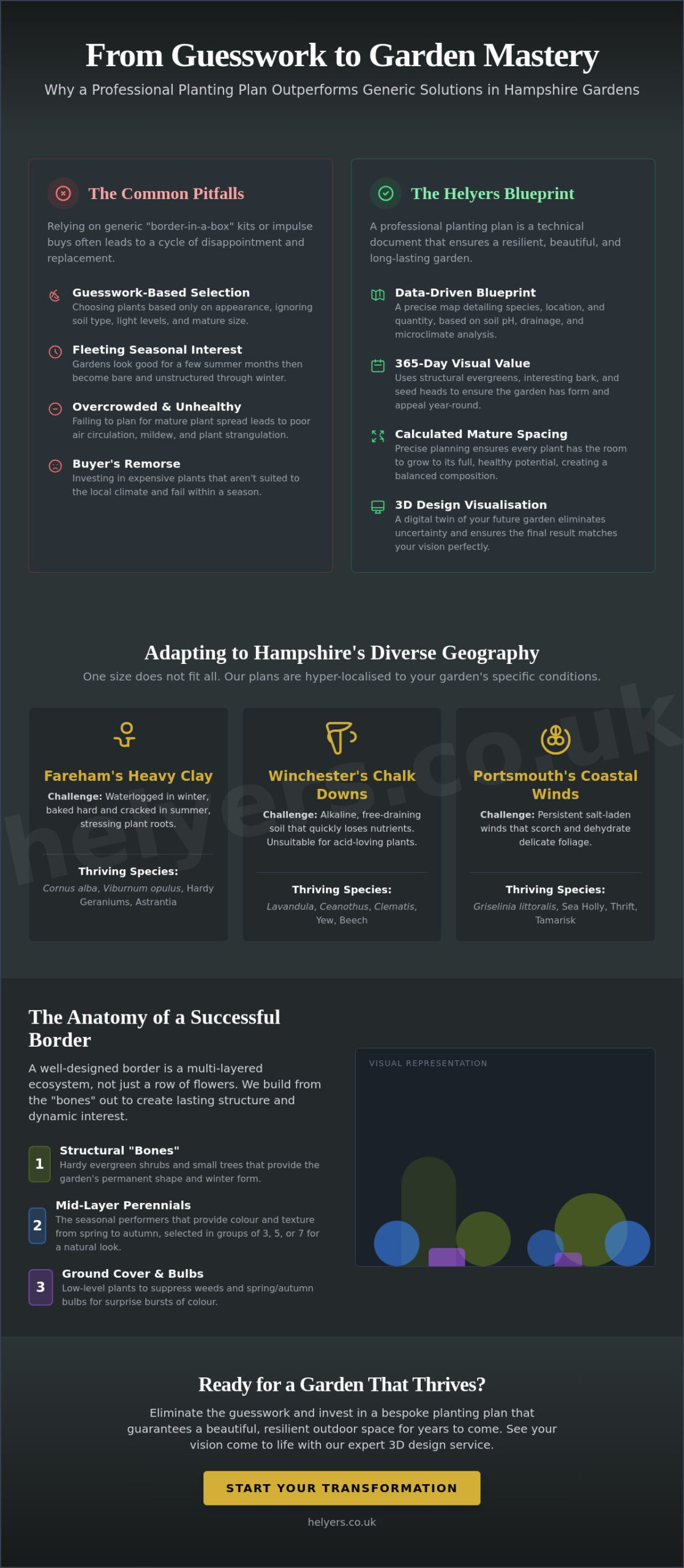
What if the heavy clay soil in areas like Fareham wasn’t a death sentence for your garden, but the foundation for a resilient, thriving landscape? For many South Coast homeowners, the reality of gardening involves a constant battle against coastal winds and borders that lose all structure once the summer fades. You likely want a garden that feels like a natural extension of your home’s architecture, yet you’re often left with high-maintenance plants that simply don’t survive the winter. At Helyers, we believe that professional planting plans are the only way to turn these local challenges into a reliable, year-round transformation.
In this guide, we’ll show you how to master garden composition to ensure your space remains vibrant and structured throughout all four seasons. You’ll learn how to eliminate the guesswork and stop the cycle of replacing dead shrubs by choosing the right plants for our specific South Coast climate. We’re sharing our proven 2026 framework for selecting durable species that thrive in Hampshire soil while delivering the bespoke, high-quality finish your property deserves. This approach moves beyond basic landscaping to create a life-enhancing outdoor environment that stands the test of time.
Key Takeaways
- Learn how to navigate Hampshire’s geological diversity by selecting species that thrive in Fareham’s clay or Winchester’s chalky soils.
- Understand why professional planting plans are essential technical maps that ensure long-term success where generic nursery kits often fail.
- Master the “Rule of Three” to create professional borders that maintain structure and visual interest even through the British winter.
- Follow a methodical guide to measuring your site and defining a bespoke style that aligns with your garden’s unique microclimate.
- Discover how Helyers integrates 3D design with expert ground preparation to deliver a high-end, durable transformation of your outdoor space.
What is a Professional Planting Plan and Why Does It Matter?
A professional planting plan is a technical horticultural document that goes far beyond a simple list of favourite flowers. It functions as a precise map for your landscape, detailing the exact location, quantity, and species of every plant within a scheme. At Helyers, we view the art and process of designing these layouts as the bridge between construction and a living, breathing environment. These planting plans account for soil pH, drainage patterns, and the specific microclimates found across Hampshire, ensuring your investment thrives long after the initial installation.
Off-the-shelf nursery kits or “border in a box” products often fail in coastal Portsmouth or the chalky uplands of Winchester. These generic collections don’t account for the salt-laden winds of the Solent or the specific light levels of a north-facing Hants garden. A professional plan moves past the idea of a “pretty border” to create a strategic ecological scheme. This approach ensures your garden remains vibrant during the bleakest Hampshire winters by using structural evergreens and plants with interesting bark or seed heads, providing 365 days of visual value.
The Core Elements of a Planting Blueprint
Every successful garden relies on a balance between structural and ornamental elements. We refer to structural plants as the “bones” of the design. These are typically hardy shrubs or trees that maintain the garden’s shape when perennials die back in November. A professional plan prevents the common mistake of overcrowded borders by calculating the precise mature spread of every species. We focus on three primary factors:
- Structural Integrity: Using evergreens and topiary to define spaces.
- Spatial Planning: Calculating 100% of the mature width to avoid plant strangulation and mildew.
- Maintenance Logic: Aligning the plant selection with your lifestyle, whether you want a high-intervention showpiece or a low-maintenance sanctuary.
Why Visualisation is Key for Hants Homeowners
Investing in a garden transformation is a significant commitment. Many homeowners struggle to translate a 2D sketch into a mental image of their future garden. This is where 3D garden design becomes an essential tool. It allows you to see how the height of a proposed Silver Birch might interact with your existing property lines or how a new hedge provides privacy from neighbours.
Seeing a digital twin of your garden reduces “buyer’s remorse” by eliminating the guesswork associated with expensive plant purchases. It also ensures that the soft landscaping perfectly complements your hardscaping. A well-conceived plan ensures that a new porcelain patio or resin-bound driveway looks integrated rather than isolated. By coordinating the textures of your foliage with the tones of your stonework, Helyers creates a cohesive outdoor living environment that adds genuine value to your Hampshire home.
Adapting Planting Plans to Hampshire’s Unique Geography
Hampshire gardens don’t follow a single rulebook because the county’s landscape is remarkably diverse. Professional planting plans must account for these shifts to ensure your outdoor space thrives year after year. In Fareham, the heavy clay soils present a specific challenge; they stay waterlogged in winter but bake hard in summer. We select species like Cornus alba or Viburnum opulus that tolerate these fluctuating moisture levels without succumbing to root rot or drought stress.
Moving inland, the chalky soils of the Winchester Downs require a different strategy. These alkaline conditions are perfect for lime-loving plants such as Lavandula, Ceanothus, and Clematis. If you try to plant acid-loving camellias here without significant soil modification, they’ll likely struggle. Along the coast in Gosport, Emsworth, and Portsmouth, the primary adversary is salt spray. We use durable, leathery-leaved hedging like Griselinia littoralis to create a protective microclimate for more delicate species further inside the garden.
The Meon Valley presents its own set of variables with sheltered valleys that often become frost pockets. In these areas, we avoid early-flowering fruit trees that might lose their entire crop to a late April freeze. Instead, we focus on late-leafing shrubs and hardy perennials that remain safely dormant until the spring temperatures truly stabilise.
Soil Testing: The Non-Negotiable First Step
You shouldn’t buy a single shrub until you understand the ground beneath your feet. We use professional testing to identify pH levels and texture, as Hampshire’s unique geology means a garden in Petersfield will have entirely different nutrient availability than one in Southampton. Soil structure refers to the physical arrangement of soil particles and the pore spaces between them, which determines how effectively a Hampshire garden manages drainage and aeration. This data allows us to specify the exact organic matter needed to transform your soil into a productive growing medium.
Climate-Resilient Species for the South Coast
Modern landscaping requires a balance between aesthetic appeal and survival. We often recommend integrating best spring trees like Amelanchier lamarckii, which provides stunning blossom while remaining tough enough to withstand coastal gusts. As South Coast summers become increasingly hot and dry, drought-tolerant options are no longer optional. We find that a blend of Mediterranean herbs like Rosmarinus and native British species like Crataegus monogyna creates a garden that’s both ecologically sound and visually striking.
This hybrid approach ensures your garden remains vibrant even during seasonal hosepipe bans. If you’re ready to see how these professional planting plans can transform your property, our team is ready to help.
The Anatomy of a Successful Border: Structure and Seasonality
Professional planting plans rely on a disciplined framework known as the “Rule of Three.” This approach balances height, form, and texture to create a cohesive aesthetic. At Helyers, we prioritise height to establish a clear hierarchy, form to provide structural interest, and texture to add tactile variety. A garden shouldn’t disappear in November. We incorporate evergreen anchors like Taxus baccata or Buxus to maintain a visible skeleton throughout the Hampshire winter. Expert research confirms that a successful garden begins with a good design that accounts for specific site conditions and long-term growth habits.
We time blooms using a succession strategy. This ensures a focal point exists from the first March snowdrops to the final October asters. We also consider the relationship between soft planting and hard landscaping. A high-quality closeboard fence or a bespoke brick wall serves as more than a boundary; it’s a canvas. Dark timber stains can make the vibrant greens of a Hebe pop, while lighter stone reflects heat, benefiting Mediterranean-style species. Our planting plans ensure that every shrub and perennial works in harmony with your existing garden structures.
Layering Techniques for Depth
Effective layering creates a sense of abundance. We place giants like Eupatorium at the back to provide privacy and a lush backdrop. The middle ground features workhorses like Geranium Rozanne, which blooms for up to 20 weeks. We finish with front-of-border “knitting” plants. These groundcovers, such as Alchemilla mollis, suppress weeds and soften the hard edges of garden paths or patios, ensuring a professional finish that requires less maintenance over time.
Colour Theory in the Hampshire Landscape
The light quality along the South Coast is unique. In Winchester, we often recommend cool palettes of blues, whites, and silvers to complement traditional cottage architecture. Conversely, the urban microclimates of Southampton allow for bold, tropical vibes using Phormiums and Canna lilies. We use foliage texture to maintain interest when flowers fade. A mix of glossy, matte, and fuzzy leaves ensures the border remains visually stimulating through the changing seasons, providing a total transformation of your outdoor space.
How to Design Your Own Planting Scheme: A Step-by-Step Guide
Creating a successful garden requires more than just picking attractive flowers at the nursery. It’s about building a resilient ecosystem that thrives in Hampshire’s specific conditions. Follow this professional five-step process to develop your own planting plans with confidence.
- Step 1: Measure and Map. Draw your garden to scale on paper. Note where the sun falls at 10:00, 13:00, and 17:00. Identify prevailing winds; these can quickly desiccate tender foliage in exposed coastal spots or elevated South Downs locations.
- Step 2: Define Your Style. Stick to a single aesthetic to avoid a cluttered look. A Contemporary Slatted style suits urban plots, while a Mediterranean theme works well on the region’s chalky, free-draining soils.
- Step 3: Select “Hero” Plants. These are your structural anchors. Choose three to five large shrubs or multi-stem trees that provide the garden’s permanent framework throughout the year.
- Step 4: Layer the “Supporting Cast”. Fill the gaps with herbaceous perennials and ornamental grasses. These provide the seasonal colour and movement that make a garden feel alive.
- Step 5: Review for Winter Interest. Look at your plan and imagine it in January. Ensure at least 25% of the scheme is evergreen or possesses architectural seed heads that stand up to the frost.
Practical Mapping and Quantification
Professional designers use grid paper to prevent expensive over-ordering. Use a 5mm grid where 1cm equals 1 metre for accuracy. To calculate quantities, use a standard density of 5 to 7 plants per square metre (m²) for 2-litre pots. Always arrange your planting plans in odd numbers. Using groups of 3, 5, or 7 prevents the eye from spotting straight lines. This creates a natural, established flow rather than a rigid, artificial layout. This simple trick is a hallmark of high-end Hampshire landscaping.
Integrating Plants with Hard Landscaping
Plants should complement your garden’s structure, not just sit alongside it. When designing borders around a new decking installation, select species like Hakonechloa macra that spill over the edges to soften the timber’s sharp lines. You can also use climbers and tall shrubs to mask the height of fencing and gates, creating a more secluded, private feel. If your project includes artificial grass, design a 300mm transition zone using decorative stone or low-growing alpines. This prevents soil from migrating onto the turf and maintains a clean finish.
Bespoke Planting as Part of Helyers’ Professional Design Service
At Helyers, we believe that high-quality planting plans deserve more than a simple delivery service. A garden is a living investment that requires a precise environment to thrive. We focus on high-end installation because the long-term success of a landscape depends on how plants are integrated into their specific site. Our process creates a practical synergy between the initial 3D design and the final horticultural finish. By managing every stage of the project, we ensure that the vision created on screen translates perfectly to the soil in your garden.
We provide a turnkey transformation that removes the stress and physical burden of DIY projects. This professional approach includes the installation of bespoke irrigation and drainage systems. These technical elements are vital for protecting your financial investment. In the UK, unpredictable weather patterns mean that automated watering and efficient runoff management are no longer luxuries. They are essential components that keep your plants healthy during dry spells and prevent waterlogging during heavy Hampshire rains. This methodical focus on infrastructure ensures your garden remains a low-maintenance asset rather than a constant chore.
Professional Soil Preparation
The “dig a hole and drop it in” method frequently fails on heavy Hampshire clay. This soil type compacts easily, which prevents roots from spreading and leads to poor drainage. Helyers uses a disciplined approach to soil conditioning. We enrich the ground with organic matter and professional-grade conditioners to improve aeration and nutrient availability. Our team focuses on the technical details of installation, ensuring that every specimen is positioned at the correct depth and given the structural support it needs. This foundation is what allows our planting plans to succeed where amateur attempts often struggle. We don’t just plant for today; we prepare the ground for a decade of growth.
The Final Transformation
Visualising the end result is much simpler when you work with a dedicated Design and Build partner. We handle the complex logistics of local projects, from the heavy machinery required for tiering a garden to the delicate placement of final perennials. This integrated service means your hard landscaping and soft planting are designed to work together. A well-executed garden requires a steady hand and a clear schedule. We manage the entire timeline so you don’t have to coordinate different trades or worry about plant health during the construction phase.
Once the final layer of mulch is applied, the transformation is complete. You are left with a durable, beautiful outdoor space that adds genuine value to your home. Our commitment to craftsmanship ensures that the beauty of your garden isn’t just temporary. It’s built to last. Ready to transform your garden? Contact Helyers for a bespoke design consultation.
Take the Next Step for Your Hampshire Garden
A successful garden is a long-term investment that requires a balance of technical knowledge and creative vision. You’ve seen how professional planting plans are essential for navigating Hampshire’s unique geography and ensuring your borders provide interest throughout all four seasons. By focusing on soil health and structural integrity, you’ll avoid common mistakes and create a space that thrives for decades. It’s about more than just aesthetics; it’s about building a durable environment that enhances your home and lifestyle.
Helyers is a family-owned Hampshire business established in 2003. We’re specialists in 3D garden design, which means you can see your future landscape in detail before any work starts. Our team brings over 20 years of local experience to every project, ensuring high-quality craftsmanship and a transparent process. We take the stress out of home improvement by delivering bespoke solutions that reflect your personal style and the specific needs of your property.
Book your expert garden design consultation with Helyers of Hampshire
We look forward to working with you to create a beautiful, lasting outdoor space you’ll be proud to own for years to come.
Frequently Asked Questions
What is the best time of year to implement a new planting plan in Hampshire?
The best times to implement new planting plans in Hampshire are early autumn and mid-spring. Autumn, specifically between September and November, allows roots to establish in soil that’s still warm before winter dormancy. Spring planting from March to May provides a full growing season before the first frost. These windows avoid the 30 degree summer peaks and frozen winter ground common in the South East.
How do I choose plants for the heavy clay soil common in Fareham and Gosport?
Select robust species like Roses, Viburnum, and Cornus for the heavy clay soils found in Fareham and Gosport. These plants tolerate the dense, nutrient-rich structure that holds water in winter and bakes hard in summer. Incorporating organic matter during the installation of your planting plans improves drainage by 15% to 20%. This ensures your garden remains healthy throughout the changing Hampshire seasons.
What are the most low-maintenance plants for a South Coast garden?
Hebes, Lavenders, and Phormiums are the most reliable low-maintenance choices for South Coast gardens. These varieties thrive in the salty air and high light levels found in coastal areas like Portsmouth and Southampton. They require minimal pruning, typically once per year, and possess a high tolerance for wind. Choosing these hardy plants reduces your weekly garden chores by approximately 3 hours during the peak growing season.
Do I need a professional designer for a small garden planting plan?
Hiring a professional for a small garden is often more critical than for a large estate. Limited space leaves no room for error, as every plant must perform a specific function. A professional ensures the scale is correct and the layout doesn’t feel cluttered. This approach prevents the common mistake of over-planting, which leads to 40% of DIY garden projects requiring redesign within three years.
How can I ensure my garden has ‘winter interest’?
Achieve winter interest by incorporating evergreen shrubs, structural grasses, and plants with ornamental bark. Species like Cornus alba ‘Sibirica’ provide vibrant red stems, while Sarcococca confusa offers scent during the coldest months. Including at least 25% evergreen content ensures the garden doesn’t look barren between December and February. This structure maintains the visual appeal of your Hampshire property throughout the entire calendar year.
Can you design a planting plan that works with artificial grass?
We frequently create planting plans that integrate seamlessly with artificial grass by using deep perimeter borders and raised beds. Softening the edges of a synthetic lawn with lush, overflowing foliage like Alchemilla mollis or Salvia creates a more natural aesthetic. This combination offers the practicality of a low-maintenance lawn with the seasonal variety of a traditional garden. It’s a popular solution for 65% of our modern urban landscaping projects.
How much does a professional planting plan typically cost for a Hampshire home?
The cost of a professional planting plan varies based on the size of the area and the complexity of the scheme. According to the Society of Garden Designers, professional fees for design work typically range from 8% to 15% of the total project budget. For a standalone planting service, prices are influenced by the number of specimens required and the soil preparation needed. Helyers provides transparent quotes following an initial site consultation to ensure accuracy.
What is the difference between a garden design and a planting plan?
A garden design focuses on the structural layout and hardscaping, while a planting plan details the specific botanical elements. Garden design includes the placement of patios, paths, and walls to define the space. The planting plan acts as a technical map, specifying the exact species, quantities, and locations for every flower and shrub. Both elements work together to create a cohesive and durable outdoor environment for your home.